Buying guide
Bread Knife for Sourdough: Serrated, Long and Bow Knives Compared by Spec Sheet
The best knife to cut sourdough bread is a long serrated bread knife: the teeth grip the hard crust, and a blade longer than the loaf is wide lets you saw in long strokes instead of pressing. Our pick is the Mercer Millennia 10-inch wavy-edge bread knife, with documented steel and a lifetime warranty in the budget price class. Bow knives and extra-long knives are options for very wide boules.
Disclosure: This page contains affiliate links (marked with *). If you buy through them, we earn a small commission at no extra cost to you. As an Amazon Associate I earn from qualifying purchases. Learn more
The short version
For sourdough, buy a serrated bread knife at least as long as your loaf is wide – 10 inches covers most batards and halved boules. Our pick is the Mercer Millennia 10-inch wavy-edge knife: high-carbon Japanese steel, 15° edge, limited lifetime warranty, budget class. Bow knives hold a serrated blade in a frame; the ones on Amazon publish listing data only.
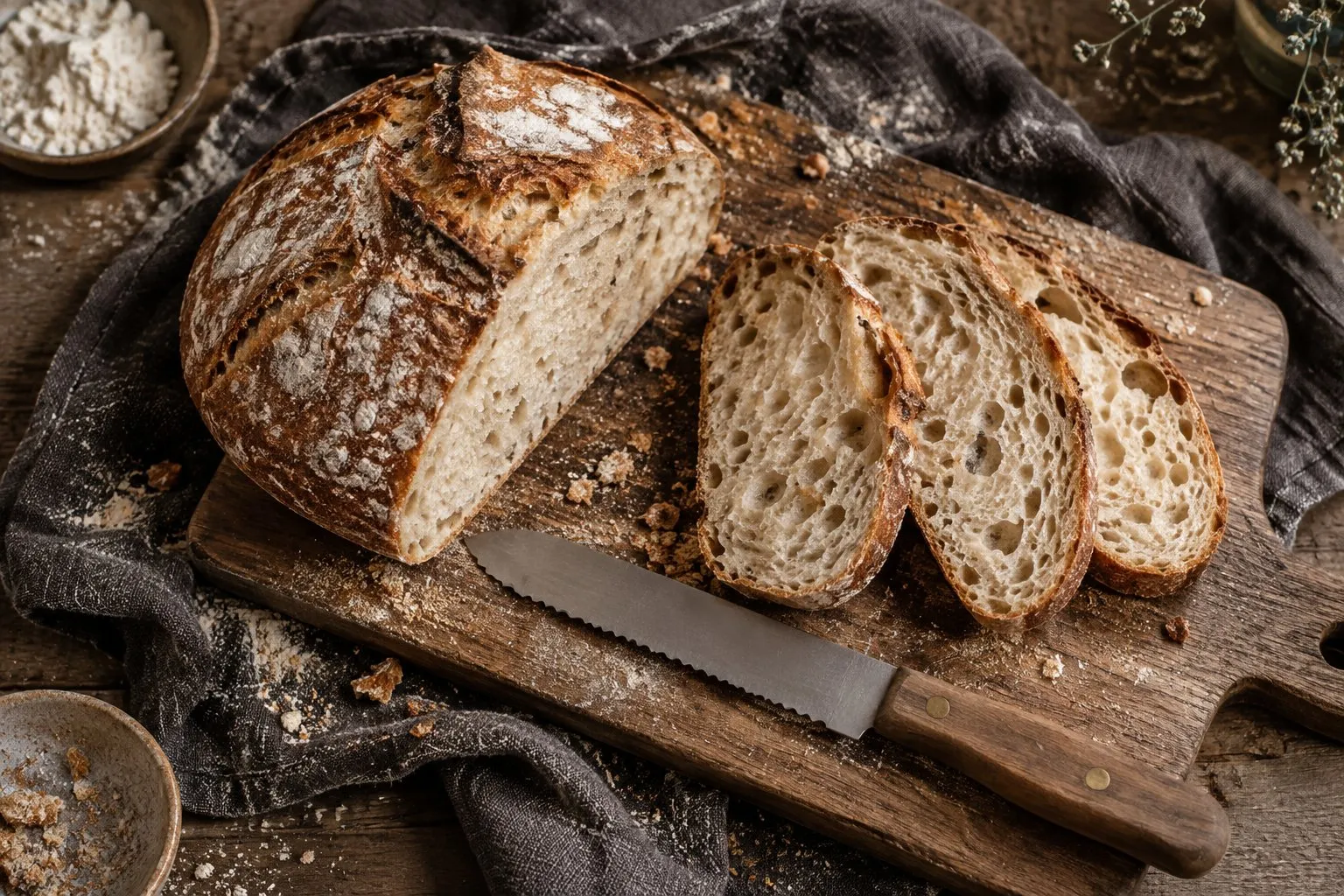
Sourdough is hard on knives. The crust is thick and often blistered, the crumb underneath is soft and open. A smooth blade tends to skid on the crust and then crush the crumb; a serrated blade bites into the crust and saws through. What separates one serrated knife from another for sourdough is mainly length, the edge and how much the maker tells you about it.
Our pick: Mercer Millennia 10-inch wavy-edge bread knife
Mercer Millennia 10" bread knife
A 10-inch wavy-edge bread knife from a foodservice cutlery maker – the tool every slicing guide needs.
Why here: Long wavy edge for crusty loaves, documented steel and warranty, budget price class.
Best for: Anyone who slices with a guide or freehand and needs a long serrated knife for crusty loaves and bagels on a board.
Strengths
- 10 in (25.4 cm) blade of one-piece high-carbon Japanese steel, 15° edge, HRC 53–54 (manufacturer)
- Wavy edge meant to get through a tough crust without tearing the soft crumb (manufacturer)
- Santoprene handle with finger guard, NSF certified, limited lifetime warranty (manufacturer)
Weaknesses
- Hand wash only – Mercer says cutlery should never go in a dishwasher
- No fence: slice thickness depends on your hand unless you add a guide
- Type
- Serrated (wavy edge) bread knife
- Blade
- 10 in (25.4 cm), high-carbon Japanese steel, 15° edge, HRC 53–54
- Slice thickness
- freehand – set by your hand or a slicing guide
Price class: Budget
View on Amazon(paid link to Amazon, opens in a new tab)Ad · paid link · check price & delivery on AmazonAdMercer Culinary is a cutlery maker; for the Millennia wide bread knife, it documents a 10-inch (25.4 cm) blade of one-piece high-carbon Japanese steel, stamped, with a 15° edge and a hardness of HRC 53–54. The wavy edge has teeth meant for tough crusts. The handle is Santoprene and polypropylene with a textured grip and a finger guard; the knife is NSF certified and carries a limited lifetime warranty. Mercer advises against the dishwasher: wash by hand, rinse, dry and store it in a block or sheath.
Ten inches is enough for most batards and for a boule cut in half – the method that also makes the slices easier to handle, described in how to slice sourdough. For a whole wide boule, a longer blade gives more reach.
Which knife fits your loaf?
Which slicer fits you?
If you bake batards or boules up to about 9 inches and want one documented knife → Mercer Millennia 10" bread knife
View(paid link to Amazon, opens in a new tab)Ad · paid link · check price & delivery on AmazonIf you want a Japanese wavy-edge knife whose maker documents the blade → Tojiro bread knife
View(paid link to Amazon, opens in a new tab)Ad · paid link · check price & delivery on AmazonIf you want to try a bow knife in the budget class → RAPSAKEMOH bow knife · Seller data only
View(paid link to Amazon, opens in a new tab)Ad · paid link · check price & delivery on AmazonIf you want identical slices without guiding the knife yourself
The options compared
| Comparison | Mercer Millennia 10" bread knife | Our pick: Japanese wavy-edge bread knifeTojiro bread knife | Seller data onlyRAPSAKEMOH bow knife | Seller data only14.5-inch bow knife |
|---|---|---|---|---|
| Type | Serrated (wavy edge) bread knife | Bread knife (sold as “bread slicer”) | Bow knife (listing) | Bow knife (listing) |
| Blade | 10 in (25.4 cm), high-carbon Japanese steel, 15° edge, HRC 53–54 | 9.25 in (235 mm) serrated, about 14.8 in (375 mm) overall (manufacturer); stainless (listing) | 15.7 in overall (listing), steel not stated | 14.5 in overall (listing), steel not stated |
| Slice thickness | freehand – set by your hand or a slicing guide | freehand | freehand | freehand |
| Loaf size | – | – | – | – |
| Size | – | – | – | – |
| Weight | – | – | – | – |
| Carriage & holder | – | – | – | – |
| Best for | Anyone who slices with a guide or freehand and needs a long serrated knife for crusty loaves and bagels on a board. | Cooks who want a Japanese wavy-edge bread knife whose maker documents blade and overall length, and who accept a higher price class for a knife. | Sourdough bakers who want to try the bow design in the budget class. | Buyers who want a bow knife in the budget class and accept listing data only. |
| Price class | Budget | Premium | Budget | Budget |
| On Amazon(paid link to Amazon, opens in a new tab)Ad · paid link · check price & delivery on Amazon | On Amazon(paid link to Amazon, opens in a new tab)Ad · paid link · check price & delivery on Amazon | On Amazon(paid link to Amazon, opens in a new tab)Ad · paid link · check price & delivery on Amazon | On Amazon(paid link to Amazon, opens in a new tab)Ad · paid link · check price & delivery on Amazon |
Tojiro F-737 bread knife
Tojiro is a Japanese knife maker, and this knife is sold on Amazon as a "Bread Knife Slicer" – it is a knife, not a machine. The listing names model F-737, which Tojiro's own page lists with a 235 mm (about 9.25 in) serrated blade and about 375 mm (14.8 in) overall – the 14.75 inches in the title are the overall length. The model has its own page: Tojiro bread slicer. Its blade is shorter than the Mercer's 10 inches, so it is not the knife for extra reach; it is the documented option if you want a Japanese wavy-edge knife. It sits in a higher price class than the Mercer.
RAPSAKEMOH bow knife
A bow knife holds a serrated blade between the two ends of a curved frame. The RAPSAKEMOH listing names a bow design and 15.7 inches and markets it for thin, even slices of sourdough and baguettes. It names no steel, blade length or handedness. Budget class, seller data only. How bow knives work and what their listings leave out is on bread bow knives.
Unbranded 14.5-inch bow knife
A second bow knife, without a brand on the listing, at 14.5 inches with an ergonomic grip and the same promise of uniform thin slices. Again no steel or blade data. Budget class, seller data only. If you are curious about the bow design, either is a low-risk way to try it; neither replaces a documented knife as a first choice.
What to look for in a sourdough knife
- Length beyond the loaf. Measure your widest loaf. The blade should be longer, so each stroke spans the crust.
- Serrated edge. Every knife here is serrated or wavy. A smooth edge has no teeth to bite into a hard crust.
- Documented steel and care. Mercer states steel, hardness, edge angle and care rules. The other listings state none of these.
- A safe grip. A finger guard or a raised grip keeps the hand off the edge when you saw hard through a crust.
- Your cooling habits. No knife cuts a hot loaf cleanly. King Arthur Baking advises letting bread cool completely before slicing, or the inside turns gummy – see when to cut sourdough.
Knife, guide or slicer?
A knife alone gives you full freedom but leaves the thickness to your hand. A slicing guide holds that knife at a fixed thickness, but the loaf must fit: the Akebono PS-955, one of the few guides with published limits, takes loaves up to about 5.5 inches wide and 7.9 inches tall. Knives that come with a clip-on guide are covered on bread knife with slicing guide, standalone guides on the bread slicing guide page. A hand-crank slicer brings its own blade: the Zassenhaus Classic cuts steplessly from 1 to 18 mm (about 1/25 to 0.7 in) with a serrated blade made in Solingen, in the premium price class. All three approaches, plus electric knives, are weighed on bread slicing tools compared.
Slicer finder
Question 1 of 4
What do you want to slice?
Cheese and cured sausage need a carriage – a bread-only crank slicer has none.
Common mistakes
- A knife shorter than the loaf. The tip disappears into the crust and you end up pushing.
- Pressing instead of sawing. It squashes the open crumb. Long strokes, light pressure.
- The dishwasher. Mercer advises against it for its knives; hand wash and dry.
- Cutting too soon. A gummy, torn slice is usually the loaf's fault, not the knife's.
Verdict
For most sourdough bakers, the Mercer Millennia 10-inch wavy-edge knife is the knife to buy: long enough for batards and halved boules, documented steel and edge, a lifetime warranty and the budget price class. For very wide whole boules, a longer knife adds reach, and bow knives are an inexpensive experiment. If you want every slice the same thickness without effort, look at the sourdough bread slicer page instead.
Mercer Millennia 10" bread knife
A 10-inch wavy-edge bread knife from a foodservice cutlery maker – the tool every slicing guide needs.
Why here: Our pick for crusty sourdough: 10-inch wavy edge, documented by the maker.
Best for: Anyone who slices with a guide or freehand and needs a long serrated knife for crusty loaves and bagels on a board.
Strengths
- 10 in (25.4 cm) blade of one-piece high-carbon Japanese steel, 15° edge, HRC 53–54 (manufacturer)
- Wavy edge meant to get through a tough crust without tearing the soft crumb (manufacturer)
- Santoprene handle with finger guard, NSF certified, limited lifetime warranty (manufacturer)
Weaknesses
- Hand wash only – Mercer says cutlery should never go in a dishwasher
- No fence: slice thickness depends on your hand unless you add a guide
- Type
- Serrated (wavy edge) bread knife
- Blade
- 10 in (25.4 cm), high-carbon Japanese steel, 15° edge, HRC 53–54
- Slice thickness
- freehand – set by your hand or a slicing guide
Price class: Budget
View on Amazon(paid link to Amazon, opens in a new tab)Ad · paid link · check price & delivery on AmazonAdQuestions readers ask
What is the best knife to cut sourdough bread?
A long serrated bread knife. The teeth bite into a hard, blistered crust without crushing the soft crumb underneath, and a long blade lets you saw instead of pushing down. Our pick is the Mercer Millennia 10-inch wavy-edge knife, whose maker documents the steel, edge angle and warranty. For boules wider than about 9 inches, a longer knife helps.
How long should a sourdough bread knife be?
Longer than the loaf is wide, so the whole crust sits within the blade's stroke. Ten inches covers most batards and a boule cut in half. For wide, whole boules, a longer blade such as a bow knife gives more reach; the 14.75 inches in the Tojiro listing are its overall length, its blade is 9.25 inches. A short knife has to be forced, which tears the crumb.
Is a bow knife good for sourdough?
A bow knife holds a thin serrated blade between the ends of a curved frame, a little like a saw. The frame keeps the blade straight, and sellers market them for even, thin sourdough slices. The bow knives on Amazon publish no steel, blade length or handedness, so we list them as seller data only and do not make one our pick.
Do I need a special knife if I have a bread slicer?
Not with a hand-crank slicer: it has its own round serrated blade. A slicing guide, on the other hand, has no blade at all – it only holds your knife at a set thickness. With a guide, the knife decides the result, so a long serrated bread knife is the first thing to get right.
Sources we read
- Mercer Culinary: Millennia Wavy Edge Wide Bread Knife 10 in (product page)
- Globalkitchen Japan: Akebono bread slicer PS-955 (technical data)
- Culinaris: Zassenhaus Bread slicing machine Classic (technical data)
- Tojiro: Bread slicer series F-737, F-687, F-629, F-828 (product page, Japanese)
- King Arthur Baking: How to tell if bread is done baking (cooling before slicing)
Keep reading
- Buying guideSourdough slicersWhich sourdough bread slicer handles a crusty boule? Hand-crank slicers and slicing guides for round loaves compared by spec sheet, with loaf-size limits.
- How-toHow to slice sourdoughHow to cut sourdough bread evenly: cool the loaf, halve a round boule, saw with a long serrated knife – plus the method for guides and hand-crank slicers.
- ComparisonBread slicing toolsBest gadget for slicing bread? Bread knife, slicing guide, hand-crank slicer, electric knife and food slicer compared by spec sheet – what each does and for whom.
- Buying guideKnives with slicing guideBread knife with slicing guide: clip-on guides, dial-set knives and bow knives with a frame – what listings promise, what is missing, and a documented alternative.
- Buying guideBread slicing guidesBread slicing guides compared by spec sheet: thickness steps, loaf size, knife or no knife, plastic or bamboo – and when a guide is the wrong tool for your loaf.
Who compares here
manualbreadslicer.com Editorial Team
Bread slicer comparisons & explainers
We are the editorial team at manualbreadslicer.com. We compare hand-crank bread slicers, slicing guides and their electric alternatives using manufacturer spec sheets, manuals, retailer data and primary sources such as Lemelson-MIT – with sources on every page. We do not run lab tests, and we say so openly.
- Spec sheets & manuals compared
- Sources on every page
- No lab tests – stated openly
- Publisher details in the imprint