Question & answer
How Long Should You Wait Before Cutting Sourdough – and What Happens If You Cut Too Early?
Wait until the loaf has cooled completely. King Arthur Baking explains that bread keeps releasing moisture as it cools and that its inner structure needs that time to set; its no-knead sourdough recipe asks for at least one hour on a rack before slicing. Cut into a hot sourdough and the crumb turns gummy.
Disclosure: This page contains affiliate links (marked with *). If you buy through them, we earn a small commission at no extra cost to you. As an Amazon Associate I earn from qualifying purchases. Learn more
The short answer
Let sourdough cool completely before you cut it – at least one hour on a rack, according to King Arthur Baking's no-knead sourdough recipe, and longer for large or dense loaves. Moist, high-rye breads can benefit from up to 24 hours. Cutting earlier interrupts the setting of the crumb, so the inside turns gummy and sticks to the blade.
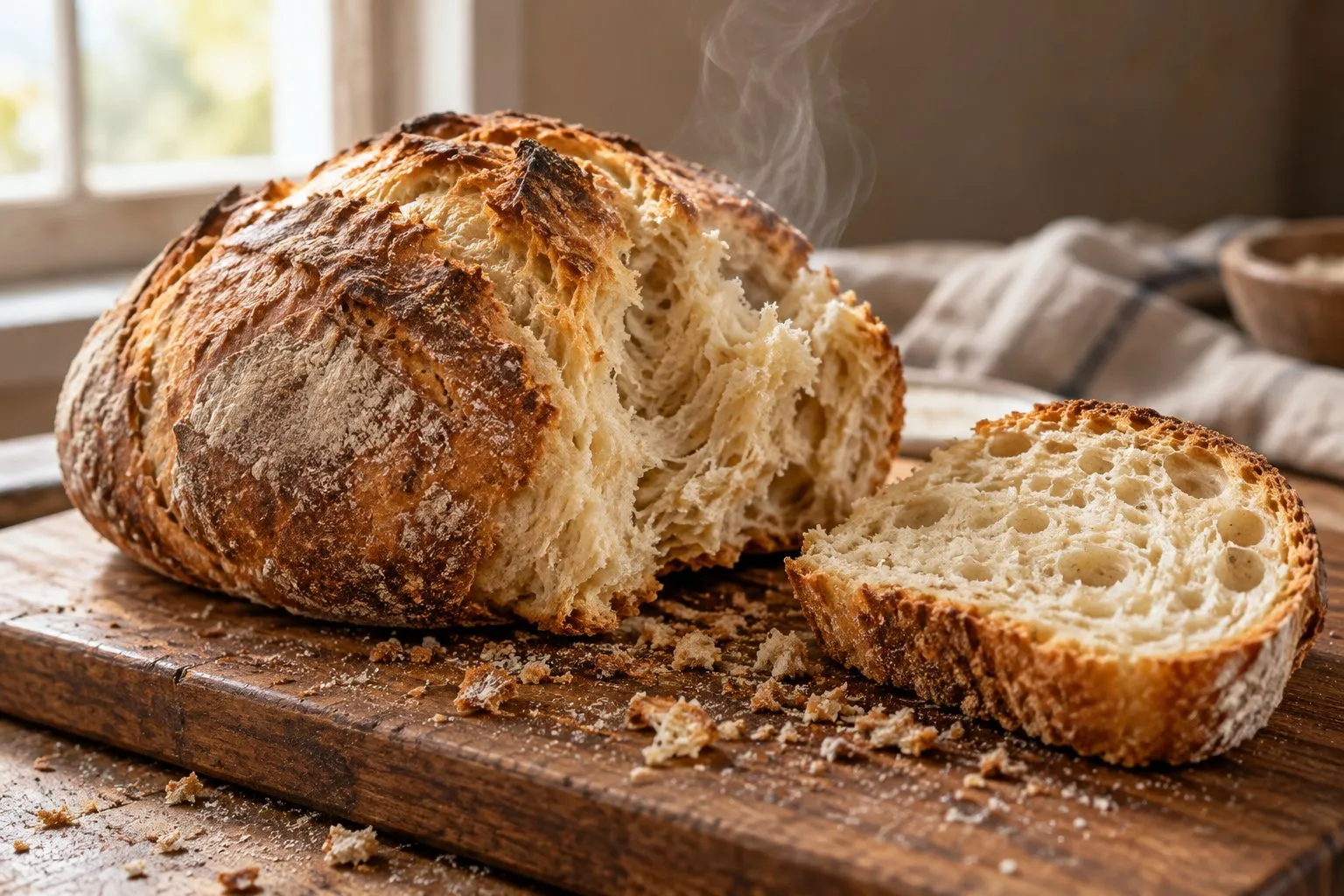
The short version: a sourdough loaf is not finished when it leaves the oven. It is finished when it has cooled. Everything below explains why, how long that takes and what to do if you want warm bread anyway.
Why the loaf needs time
King Arthur Baking's bread experts put it plainly: bread is not fully done when it comes out of the oven. As it cools, it keeps releasing moisture, and the inner structure of the loaf needs that time to set. Their advice is to let bread cool completely before slicing unless you want a gummy interior.
A thermometer reading does not shortcut this. King Arthur's Vermont Sourdough is baked to about 210°F inside and then cooled completely on a rack; its no-knead sourdough also reaches at least 210°F and then rests for at least an hour. Done baking and ready to cut are two separate moments.
How long to wait
| Loaf | Earliest cut, per the source | Source |
|---|---|---|
| No-knead sourdough (Dutch oven) | at least 1 hour on a rack | King Arthur no-knead sourdough |
| Vermont Sourdough (rounds or oblong loaves) | when cooled completely | King Arthur recipe |
| Crusty no-knead loaf (yeasted) | when just barely warm | King Arthur recipe |
| Moist, dense high-rye bread | often benefits from up to 24 hours | King Arthur blog |
One hour is a minimum, not a target. A large boule holds heat longer than a small batard, so check the loaf rather than the clock: the bottom and the center of the crust should no longer feel warm. We found no measured cooling curve for sourdough loaves, so no exact number of hours applies to every loaf.
What happens if you cut too early
- Gummy crumb. The interior has not set. King Arthur calls hot-sliced bread irretrievably gummy.
- Torn slices. Soft, moist crumb drags along the serrations, so the slice rips at the bottom instead of falling away cleanly. This is true with a bread knife, a slicing guide and a hand-crank slicer alike.
- Moisture loss. The steam you see rising from the cut is moisture leaving the loaf through the open face.
A slicer cannot fix a loaf that is too warm. If the crumb tears on a cooled loaf, the cause is more likely the blade or the technique – see how to slice sourdough for the step-by-step method and bread slicer replacement blades if a crank slicer has gone dull.
Warm bread without cutting it hot
You can have both. Let the loaf cool, slice it, then rewarm. King Arthur suggests refreshing slices in the toaster, or wrapping the loaf loosely in foil and warming it for 5 to 10 minutes in a preheated 350°F oven. Store a completely cooled loaf well wrapped at room temperature; its Vermont Sourdough keeps loosely wrapped for up to 5 days.
Once it has cooled
A cooled crusty loaf still needs a long serrated edge. The Mercer Millennia 10-inch bread knife* has a wavy edge that Mercer designs for tough crusts; the full choice of knives, including bow knives, is on our page about the best bread knife for sourdough. If you slice a whole loaf several times a week, a crank slicer may be worth it – the options for round loaves are on the sourdough bread slicer page, and the broader question is answered under are bread slicers worth it. More short answers are collected under questions and answers.
Questions readers ask
What happens if you cut sourdough too early?
The crumb is still setting and still giving off moisture. Cut into it hot and the interior turns gummy, a result King Arthur Baking describes as irretrievable for a hot loaf. Steam escapes from the cut face, the soft crumb drags along the knife and the slices tear instead of separating cleanly.
Can you cut sourdough while it is still warm?
Barely warm is the earliest point King Arthur suggests for its crusty no-knead loaf; its general advice is to let bread cool completely. If you want warm bread at the table, cool the loaf, slice it and then rewarm: King Arthur suggests the toaster for slices, or the foil-wrapped loaf for 5 to 10 minutes in a 350°F oven.
Why does rye sourdough need longer?
King Arthur Baking's bread experts note that moist, dense rye breads with a high share of rye flour often benefit from up to 24 hours of cooling. A light wheat sourdough is ready much sooner, but the same rule applies: wait until it has cooled through, not just the crust.
Sources we read
Keep reading
- How-toHow to slice sourdoughHow to cut sourdough bread evenly: cool the loaf, halve a round boule, saw with a long serrated knife – plus the method for guides and hand-crank slicers.
- Buying guideSourdough slicersWhich sourdough bread slicer handles a crusty boule? Hand-crank slicers and slicing guides for round loaves compared by spec sheet, with loaf-size limits.
- Buying guideSourdough bread knifeWhich sourdough bread knife cuts a crusty boule cleanly? Blade length, serrated edges and bow knives explained, with our pick and the alternatives compared by spec.
- Question & answerAre Bread Slicers Worth It?Are bread slicers worth it? It depends on how many loaves you slice, how thin you like them and your loaf size – a guide, a crank slicer or just a good bread knife.
Who compares here
manualbreadslicer.com Editorial Team
Bread slicer comparisons & explainers
We are the editorial team at manualbreadslicer.com. We compare hand-crank bread slicers, slicing guides and their electric alternatives using manufacturer spec sheets, manuals, retailer data and primary sources such as Lemelson-MIT – with sources on every page. We do not run lab tests, and we say so openly.
- Spec sheets & manuals compared
- Sources on every page
- No lab tests – stated openly
- Publisher details in the imprint