Comparison
Bread Slicing Guide or Hand-Crank Slicer? A Decision by Loaf Shape, Frequency and Budget
Take a slicing guide if your loaves are narrow enough to fit between its walls, you slice a loaf or two a week and you already own a good bread knife. Take a hand-crank slicer if you bake wide or crusty loaves, slice several times a week or want very thin slices. The loaf size decides first – and only some guides state their limit.
Disclosure: This page contains affiliate links (marked with *). If you buy through them, we earn a small commission at no extra cost to you. As an Amazon Associate I earn from qualifying purchases. Learn more
The short version
A bread slicing guide is a budget frame that steadies your own bread knife; it fits a drawer but only takes loaves narrower than its walls – the Akebono PS-955 up to 5.5 inches wide and 7.9 inches tall. A hand-crank slicer cuts with its own serrated blade, has no side walls and sets the thickness steplessly, but needs counter space and brand models are premium.
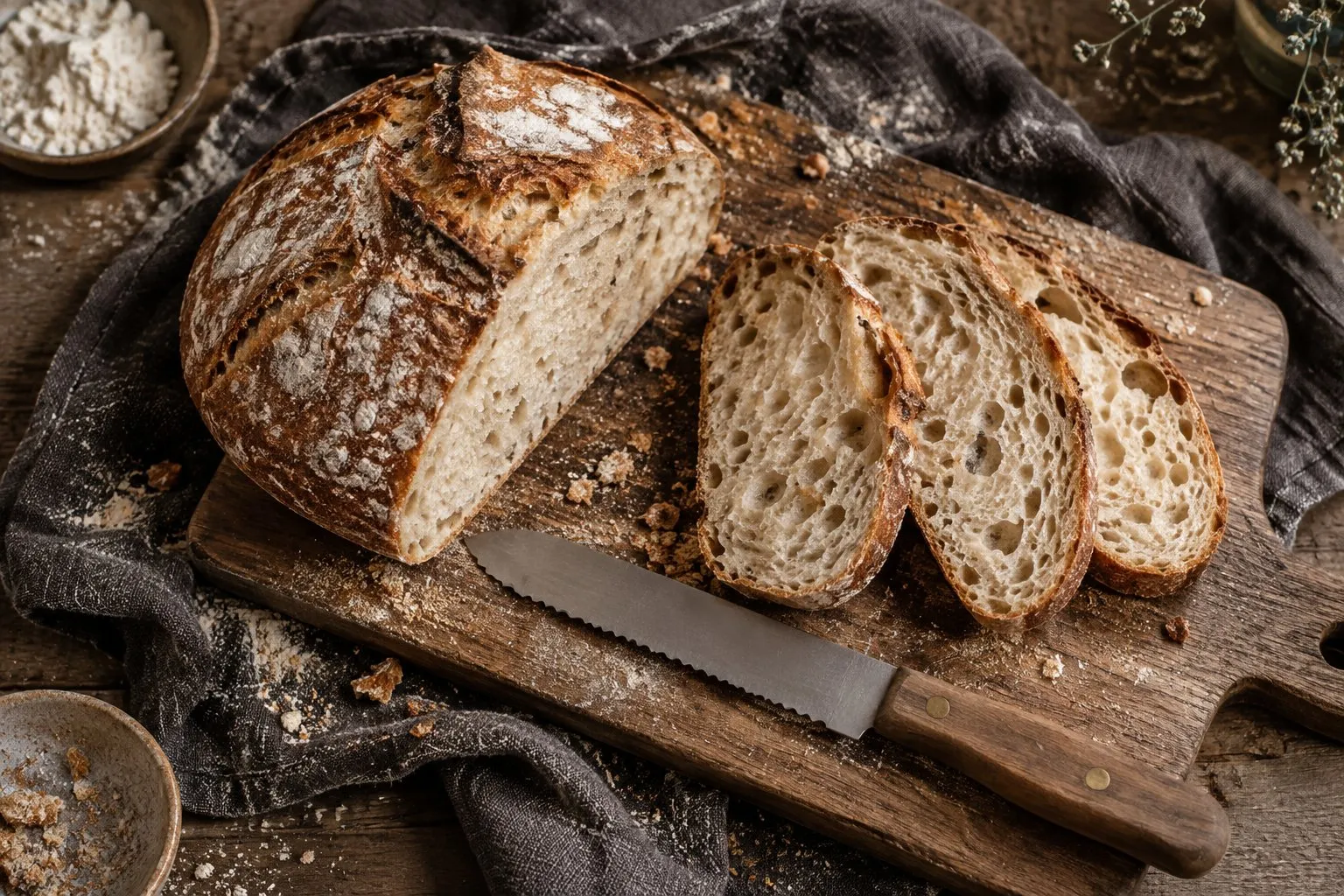
Both answers circulate: AI assistants and listicles recommend a knife plus guide "for most home bakers" or a crank slicer "for frequent bakers", and neither names the limits that actually decide. There is no independent test comparing the two designs. What exists are spec sheets – and they show that the loaf size settles the question before anything else does.
Short verdict
- Guide if your loaf is narrower than the guide's walls, you slice one or two loaves a week, you own a good serrated bread knife and storage space is tight. Our pick: the Akebono PS-955.
- Hand-crank slicer if you bake wide or crusty loaves, slice several times a week, want very thin slices or do not want to depend on your knife. Our pick: the Zassenhaus Classic.
Akebono PS-955 guide
A compact Japanese slicing guide with five fixed thicknesses and a crumb tray – you bring your own bread knife.
Why here: The guide with documented limits – check your loaf against 7.9 × 5.5 inches before you decide.
Best for: Sandwich and pan loaves up to 7.9 in tall and 5.5 in wide, sliced with your own bread knife.
Strengths
- Five settings: 10, 15, 20, 25 and 30 mm (about 0.4 to 1.2 in)
- Light: about 13 oz (374 g), 9.3 × 6.3 × 2.7 in – fits a drawer
- Removable crumb tray, made in Tsubame, Japan
Weaknesses
- No knife included
- Loaf up to about 7.9 in high and 5.5 in wide – too narrow for most round boules
- Hand wash only; plastic parts heat-resistant to 70–120 °C (158–248 °F) per part
- Type
- Slicing guide for a bread knife
- Blade
- none – bread knife sold separately
- Slice thickness
- 10 / 15 / 20 / 25 / 30 mm (about 0.4–1.2 in)
- Loaf size
- up to 7.9 in high × 5.5 in wide (200 × 140 mm)
- Size
- 9.3 × 6.3 × 2.7 in (235 × 159 × 69 mm)
- Weight
- about 13 oz (374 g)
Price class: Budget
View on Amazon(paid link to Amazon, opens in a new tab)Ad · paid link · check price & delivery on AmazonLearn more AdThe two designs side by side
| Slicing guide | Hand-crank slicer | |
|---|---|---|
| What cuts | Your own bread knife | Its own round serrated blade |
| Thickness | Fixed slots (Akebono: 10/15/20/25/30 mm) or adjustable rails | Adjustable fence, often stepless (Zassenhaus: 1–18 mm) |
| Loaf width | Limited by the walls (Akebono: 5.5 in) | No side walls |
| Loaf height | Limited by the walls (Akebono: 7.9 in) | Limited by the blade reach, rarely stated |
| Size and weight | Akebono: 9.3 × 6.3 × 2.7 in, about 13 oz | Zassenhaus: about 11.8 × 10 × 7.5 in, 5.3 lb |
| Storage | Drawer | Counter or cabinet shelf |
| Price class | Budget | Budget to mid-range (no-name), premium (brand) |
| Main risk | Your own knife blade | Sliding base, last piece of the loaf, exposed blade |
Sources: Globalkitchen Japan and Culinaris technical data, read 22 October 2026.
| Comparison | Our pick: slicing guideAkebono PS-955 guide | Seller data onlyKiss Core slicing guide | Our pick: hand-crank slicerZassenhaus Classic | Seller data onlyBrvclon hand-crank slicer |
|---|---|---|---|---|
| Type | Slicing guide for a bread knife | Slicing guide for a bread knife | Hand-crank slicer for bread | Hand-crank slicer for bread |
| Blade | none – bread knife sold separately | – | Round serrated stainless blade, made in Solingen (diameter not stated) | – |
| Slice thickness | 10 / 15 / 20 / 25 / 30 mm (about 0.4–1.2 in) | – | 1–18 mm stepless (about 1/25–0.7 in) | adjustable with scale line (listing) |
| Loaf size | up to 7.9 in high × 5.5 in wide (200 × 140 mm) | adjustable width (listing) | – | – |
| Size | 9.3 × 6.3 × 2.7 in (235 × 159 × 69 mm) | – | 11.8 × 10 × 7.5 in (30 × 25.5 × 19 cm) | – |
| Weight | about 13 oz (374 g) | – | 5.3 lb (2.4 kg) | – |
| Carriage & holder | – | Crumb tray, folds flat (listing) | Beechwood base, no carriage or end-piece holder listed | Metal guide, suction cups, wood base (listing) |
| Best for | Sandwich and pan loaves up to 7.9 in tall and 5.5 in wide, sliced with your own bread knife. | Occasional bakers who already own a good bread knife and want a foldable plastic guide. | Households that mostly slice bread and want a brand crank slicer with documented specs and a compact footprint. | Buyers who want the hand-crank principle in the budget to mid-range price class and can live with listing data only. |
| Price class | Budget | Budget | Premium | Budget to mid-range |
| On Amazon(paid link to Amazon, opens in a new tab)Ad · paid link · check price & delivery on Amazon | On Amazon(paid link to Amazon, opens in a new tab)Ad · paid link · check price & delivery on Amazon | On Amazon(paid link to Amazon, opens in a new tab)Ad · paid link · check price & delivery on Amazon | On Amazon(paid link to Amazon, opens in a new tab)Ad · paid link · check price & delivery on Amazon |
The differences, point by point
1. Loaf shape and size
This is the first filter. A guide holds the loaf between two walls; a loaf wider than the gap does not go in. The Akebono PS-955 documents 140 mm (about 5.5 in) of width and 200 mm (about 7.9 in) of height. Adjustable guides such as the Kiss Core widen the gap, but their listings do not state a maximum. A crank slicer has no side walls, so a wide sourdough boule is not blocked by a frame; its limit is how high the blade reaches, and none of the crank slicers we compare states it. Round loaves are covered in detail on the sourdough bread slicer page.
2. How often you slice
With a guide, every slice is a sawing motion with your knife, guided by the slot. With a crank slicer, the blade does the cutting while you turn and push. We have no measured time per loaf for either, but the work shifts from your knife hand to the crank. If you slice daily, that difference adds up; for a loaf a week, a guide is usually enough.
3. Slice thickness
Guides with fixed slots give a few set thicknesses – the Akebono offers five from 10 to 30 mm (about 0.4 to 1.2 in). Crank slicers usually adjust steplessly: the Zassenhaus Classic from 1 to 18 mm, the Graef H9 from 0 to 15 mm. If you want very thin slices, a crank slicer is the documented route; if you want thick slices for French toast, the Akebono's 30 mm slot goes further than the documented crank slicers, which stop at about 20 mm.
4. The knife
A guide is only as good as your bread knife. A dull knife makes even a good guide frustrating. Some guides, such as the Bambüsi, include a knife. A crank slicer brings its own serrated blade, so you do not need a good knife at all.
5. Storage and weight
A guide fits a drawer: the Akebono is 2.7 inches high and weighs about 13 oz. Brand crank slicers weigh 5.3 to 7.3 lb and none of them is described as foldable. Foldable options of both kinds are compared on the foldable bread slicer page.
6. Price class
Guides sit in the budget price class. Unbranded crank slicers are budget to mid-range, brand crank slicers premium. Whether the jump is worth it is the question on are bread slicers worth it.
7. Safety
With a guide, the risk is your own knife. A hand-crank slicer has no motor and no cord; its risks are a base that slides, the last piece of the loaf when fingers get close to the blade, and cleaning the exposed edge. Suction feet, a carriage with thumb guard or an end-piece holder reduce them.
Take a guide if … take a crank slicer if …
Which slicer fits you?
If your loaf is narrower than 5.5 inches and lower than 7.9 inches, and you own a good bread knife → Akebono PS-955 guide
View(paid link to Amazon, opens in a new tab)Ad · paid link · check price & delivery on AmazonIf you bake wide or crusty loaves, slice often or want very thin slices → Zassenhaus Classic
View(paid link to Amazon, opens in a new tab)Ad · paid link · check price & delivery on AmazonIf you want to compare every guide design first
If you want to understand how a crank slicer works first
All crank slicers with their specs are in our comparison of manual bread slicers, and the homepage gives the overview of manual bread slicers.
Questions readers ask
Do hand-crank slicers work better than a bread knife with a slicing guide for crusty sourdough?
For wide, crusty boules a hand-crank slicer has the clearer advantage on paper: it has no side walls, and its serrated round blade does the sawing. A guide only works if the loaf fits between its walls – the documented Akebono PS-955 takes 5.5 inches of width. No independent test compares both designs, so this is a decision by dimensions, not by measured cut quality.
What is the difference between a bread slicing guide and a bread slicer?
A slicing guide is a frame of plastic, bamboo or steel with slots or rails; you saw with your own bread knife, and the slot sets the thickness. A hand-crank bread slicer has its own round serrated blade turned by a crank, and an adjustable fence sets the thickness. Both are manual – neither has a motor.
Is a slicing guide enough for one loaf a week?
Often yes, if the loaf fits and your bread knife is sharp. A guide sits in the budget price class, stores in a drawer and gives you a fixed thickness every time. A crank slicer starts to pay off when you slice often, bake loaves too wide for a guide or want slices thinner than a guide's slots allow.
Sources we read
Keep reading
- Buying guideBread slicing guidesBread slicing guides compared by spec sheet: thickness steps, loaf size, knife or no knife, plastic or bamboo – and when a guide is the wrong tool for your loaf.
- Buying guideHand-crank slicersHow a hand-crank bread slicer works, what the spec sheets say about thickness, blade and carriage, and which rotary slicer fits your loaf – no motor, no cord.
- ComparisonBest manual bread slicersThe best manual bread slicers compared by spec sheet: Zassenhaus Classic, Graef H9, ritter manus 3 and seven budget crank slicers – slice range, size, price class.
- Buying guideSourdough slicersWhich sourdough bread slicer handles a crusty boule? Hand-crank slicers and slicing guides for round loaves compared by spec sheet, with loaf-size limits.
- Question & answerAre Bread Slicers Worth It?Are bread slicers worth it? It depends on how many loaves you slice, how thin you like them and your loaf size – a guide, a crank slicer or just a good bread knife.
Who compares here
manualbreadslicer.com Editorial Team
Bread slicer comparisons & explainers
We are the editorial team at manualbreadslicer.com. We compare hand-crank bread slicers, slicing guides and their electric alternatives using manufacturer spec sheets, manuals, retailer data and primary sources such as Lemelson-MIT – with sources on every page. We do not run lab tests, and we say so openly.
- Spec sheets & manuals compared
- Sources on every page
- No lab tests – stated openly
- Publisher details in the imprint