How-to
How to Slice Sourdough Bread: Boules, Batards and Thin Sandwich Slices
The best way to cut sourdough bread is to let the loaf cool completely, then saw through it with a long serrated knife using light pressure. Cut a round boule in half first and lay each half cut side down, so you slice half-moons that fit a toaster and a sandwich. For many identical thin slices, a slicing guide or a hand-crank slicer does the measuring for you.
Disclosure: This page contains affiliate links (marked with *). If you buy through them, we earn a small commission at no extra cost to you. As an Amazon Associate I earn from qualifying purchases. Learn more
The short version
To slice sourdough: wait until the loaf has cooled completely (at least an hour, per King Arthur Baking), use a serrated knife longer than the loaf is wide, and let the teeth saw rather than pressing down. Halve a round boule through the middle, set each half cut side down and slice across. A batard is sliced straight across from one end.
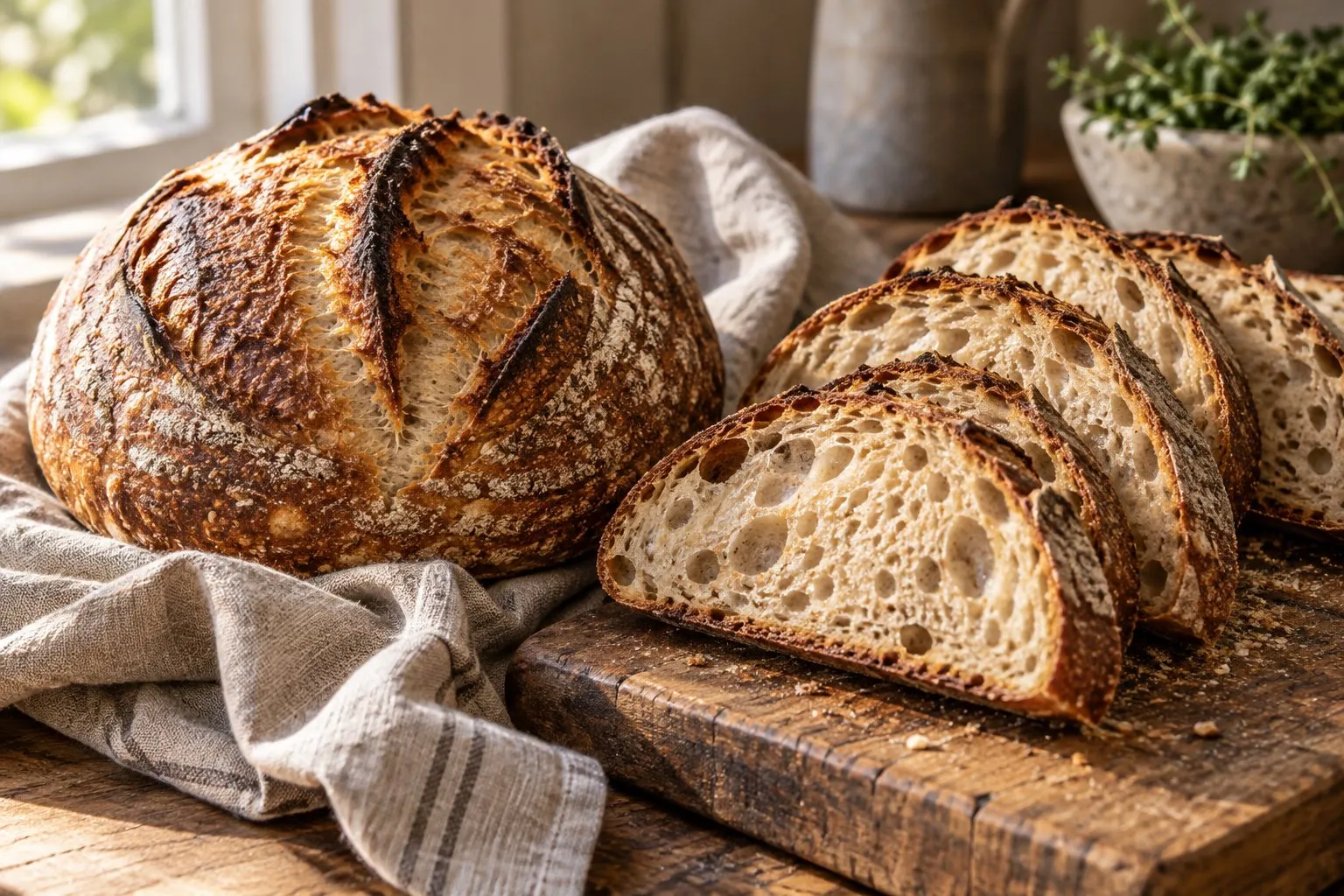
Even sourdough slices take about five minutes and one tool you probably own: a long serrated knife. The two things that go wrong most often are cutting too early and pressing too hard. Both are easy to avoid. The same method works whether you finish with a knife alone or with a manual bread slicer.
What you need
- A fully cooled loaf. How long that takes is covered in how long to wait before cutting sourdough.
- A serrated bread knife, ideally longer than your loaf is wide. Mercer, for example, describes the wavy edge of its 10-inch Millennia knife as made for cutting through tough crusts.
- A cutting board with room for the loaf and the slices.
- Optional: a slicing guide or a hand-crank slicer for identical slices.
Mercer Millennia 10" bread knife
A 10-inch wavy-edge bread knife from a foodservice cutlery maker – the tool every slicing guide needs.
Why here: A 10-inch wavy-edge bread knife – long enough for most batards and halved boules, and the knife a slicing guide needs.
Best for: Anyone who slices with a guide or freehand and needs a long serrated knife for crusty loaves and bagels on a board.
Strengths
- 10 in (25.4 cm) blade of one-piece high-carbon Japanese steel, 15° edge, HRC 53–54 (manufacturer)
- Wavy edge meant to get through a tough crust without tearing the soft crumb (manufacturer)
- Santoprene handle with finger guard, NSF certified, limited lifetime warranty (manufacturer)
Weaknesses
- Hand wash only – Mercer says cutlery should never go in a dishwasher
- No fence: slice thickness depends on your hand unless you add a guide
- Type
- Serrated (wavy edge) bread knife
- Blade
- 10 in (25.4 cm), high-carbon Japanese steel, 15° edge, HRC 53–54
- Slice thickness
- freehand – set by your hand or a slicing guide
Price class: Budget
View on Amazon(paid link to Amazon, opens in a new tab)Ad · paid link · check price & delivery on AmazonAdStep by step with a bread knife
Let the loaf cool completely
King Arthur Baking's bread experts explain that moisture keeps leaving the loaf as it cools and the inside needs that time to set. Its no-knead sourdough rests at least one hour on a rack. Larger and rye-heavy loaves need longer.Pick a long serrated knife
The blade should reach across the loaf with room to spare. A short knife has to be forced, and forcing is what tears the crumb.Halve a round boule
Cut the boule from the top straight through the center. A batard does not need this step; slice it from one end.Lay the halves cut side down
Each half now stands on a flat face. It cannot roll, and every slice comes out as a half-moon that fits a toaster and a sandwich.Saw with light pressure
Long, even strokes, little downward force. The serrations cut the crust; your arm only guides the knife.Keep the thickness even
Look down at the blade, not from the side, and keep it upright. For many identical slices, use a guide or a crank slicer.Store the rest cut side down
The crust protects the loaf; the open crumb dries fastest. Set it face down on the board or wrap it loosely.
Boule, batard or sandwich slices
| Loaf | How to cut | Watch out for |
|---|---|---|
| Round boule | Halve through the center, then slice each half across | Center slices get very long if you skip the halving |
| Batard (oval) | Slice straight across from one end | Keep the knife upright so slices do not wedge |
| Pan sourdough | Slice across like a sandwich loaf | Domed top: start the cut at the crust's highest point |
| Thin sandwich slices | Short strokes on a fully cooled loaf, or a guide or crank slicer | Open crumb tears when slices get very thin freehand |
With a slicing guide
A guide holds the knife at a fixed thickness, but the loaf has to fit between its walls. The Akebono PS-955, one of the few guides with published limits, takes loaves up to about 5.5 inches wide and 7.9 inches tall. A halved boule laid cut side down often fits where the whole loaf does not. Longer guides such as the 13-inch guide for sourdough rounds* are marketed for wide loaves but do not state a maximum height. Guide or crank – the trade-offs are on slicing guide or hand-crank slicer.
With a hand-crank slicer
The Zassenhaus Classic manual describes the method in a few lines: set the slicer on a firm, flat, smooth surface and fix the suction feet, choose the thickness with the adjustment knob, press the bread lightly against the slicer and turn the crank clockwise. For soft food it suggests turning the crank quickly while pushing the loaf slowly. And for the end of the loaf, it asks you to protect your fingers, for example with a cake fork as a holder. The mechanism itself is explained on the hand-crank bread slicer page; models for round loaves are compared on the sourdough bread slicer page.
Common mistakes
- Cutting a warm loaf. The crumb turns gummy and tears – no knife fixes that.
- Pressing down. It flattens the soft crumb against the crust and squeezes the slice out of shape.
- A knife that is too short or dull. If even a cooled loaf tears, the edge is the likely cause. Choosing a better one is covered on the best bread knife for sourdough; other causes are on why sourdough is hard to cut.
- Holding the loaf at the end. Keep the steadying hand on top of the loaf, behind the blade. On a crank slicer, use the end-piece holder or a fork for the last piece.
Safety
A bread knife and a crank-slicer blade are both sharp. The Zassenhaus manual warns that the circular knife is sharp during use, transport and especially cleaning, and asks you to check before each use that the slicer stands firmly. A hand-crank slicer has no motor and no cord, so the real risks are a base that slides, the last piece of the loaf and wiping the exposed blade.
Questions readers ask
What is the best way to cut sourdough bread?
Wait until it has cooled completely, then use a long serrated bread knife with a gentle sawing motion and little downward pressure. For a round boule, cut it in half first and slice each half cut side down. That keeps the slices a manageable size and gives the knife a flat, stable base to work from.
How do you cut sourdough bread thin for sandwiches?
Use a fully cooled loaf, a sharp serrated knife and short sawing strokes. Thin, identical slices are where tools help: a hand-crank slicer such as the Zassenhaus Classic sets the fence steplessly from 1 mm, and a slicing guide holds the knife at a fixed thickness. Freehand, very thin slices of open crumb tend to tear.
How do you cut a round sourdough boule?
Halve it from the top through the center, lay both halves cut side down and slice each one across into half-moon slices. Cutting a whole boule straight through gives a few very large center slices and small end slices; halving evens them out. It also lets a boule that is too wide for a slicing guide fit into one.
Which side of a sourdough loaf should you cut first?
For a boule, start with the halving cut through the top crust. Then work from the cut face so the blade enters the crumb and crust together. With a batard, slice from one end. Keep the hand that steadies the loaf on top of it, well behind the path of the blade.
Sources we read
- King Arthur Baking: How to tell if bread is done baking (cooling before slicing)
- King Arthur Baking: How to make no-knead sourdough bread
- Mercer Culinary: Millennia Wavy Edge Wide Bread Knife 10 in (product page)
- Zassenhaus: Bread slicer CLASSIC user's guide (PDF, Küchenprofi Group)
- Globalkitchen Japan: Akebono bread slicer PS-955 (technical data)
Keep reading
- Question & answerHow Long Should You Wait Before Cutting Sourdough – and What Happens If You Cut Too Early?How long to wait before cutting sourdough: cool it completely, at least an hour per King Arthur, longer for rye. What cutting a hot loaf does to the crumb.
- Buying guideSourdough slicersWhich sourdough bread slicer handles a crusty boule? Hand-crank slicers and slicing guides for round loaves compared by spec sheet, with loaf-size limits.
- Buying guideSourdough bread knifeWhich sourdough bread knife cuts a crusty boule cleanly? Blade length, serrated edges and bow knives explained, with our pick and the alternatives compared by spec.
- ComparisonGuide vs. hand crankBread slicing guide or hand-crank slicer? How loaf width, height, how often you slice, storage and price class decide – compared by spec sheet, not by opinion.
- Buying guideHand-crank slicersHow a hand-crank bread slicer works, what the spec sheets say about thickness, blade and carriage, and which rotary slicer fits your loaf – no motor, no cord.
Who compares here
manualbreadslicer.com Editorial Team
Bread slicer comparisons & explainers
We are the editorial team at manualbreadslicer.com. We compare hand-crank bread slicers, slicing guides and their electric alternatives using manufacturer spec sheets, manuals, retailer data and primary sources such as Lemelson-MIT – with sources on every page. We do not run lab tests, and we say so openly.
- Spec sheets & manuals compared
- Sources on every page
- No lab tests – stated openly
- Publisher details in the imprint