Comparison
Best Tool for Slicing Bread: Bread Knife, Slicing Guide, Crank Slicer or Electric Knife?
The best tool for slicing bread is the one that matches how often you slice and how even the slices must be. For most kitchens that starts with a long serrated bread knife – our pick is the 10-inch Mercer Millennia. Add a slicing guide if you want equal slices, and move to a hand-crank slicer if you slice wide or crusty loaves several times a week.
Disclosure: This page contains affiliate links (marked with *). If you buy through them, we earn a small commission at no extra cost to you. As an Amazon Associate I earn from qualifying purchases. Learn more
The short version
A long serrated bread knife is the base tool: budget, fits a drawer, works on any loaf. A slicing guide adds fixed thicknesses for loaves that fit between its walls. A hand-crank slicer brings its own blade and a stepless fence for frequent slicing. An electric knife adds a motor but no fence, and a home food slicer stops at 1/2 inch.
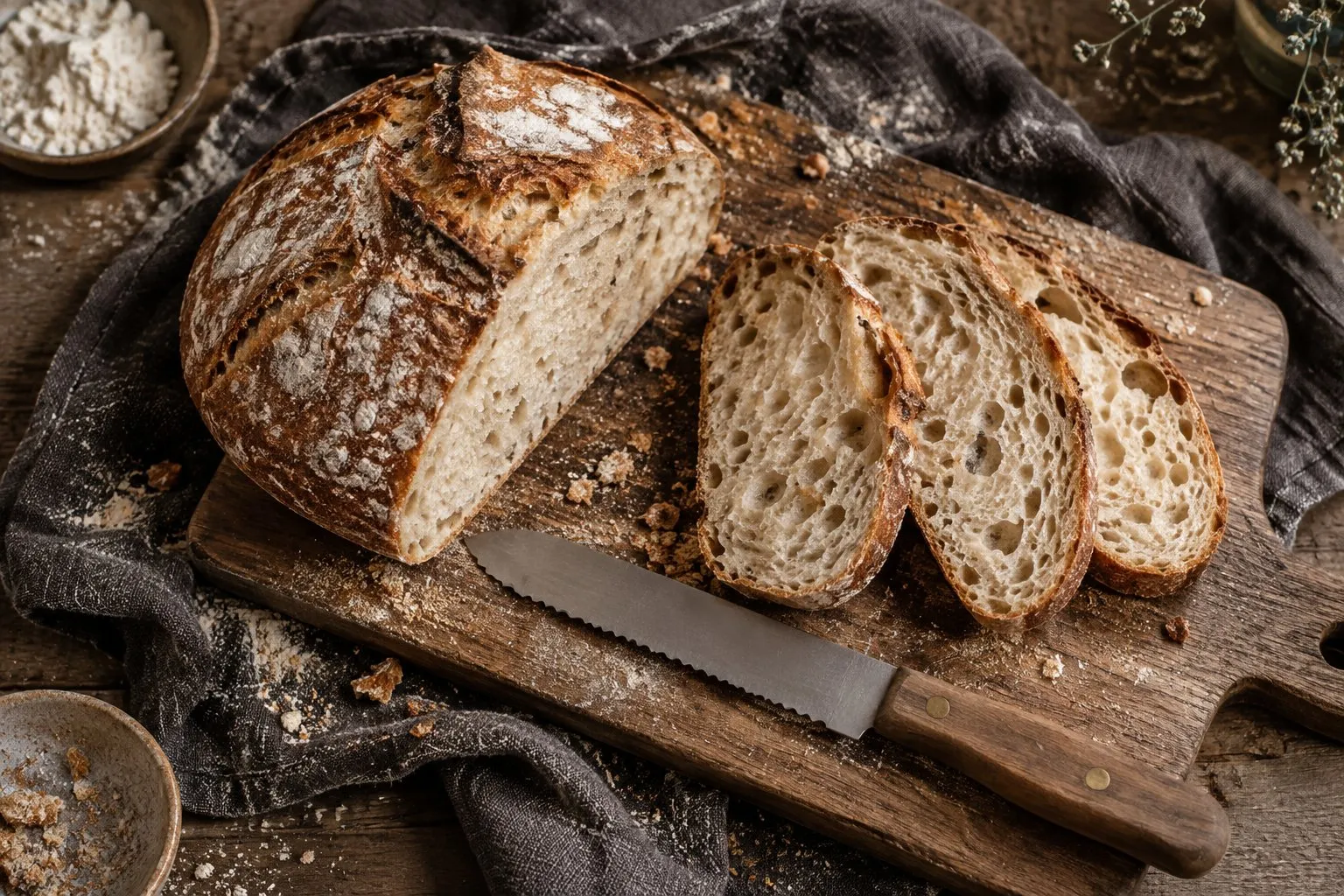
“What is the best gadget for slicing bread?” appears in the Google question box on four of the result pages we checked, and the answers around it are mostly listicles. There is no independent test that compares the whole range of tools. What exists are spec sheets and manufacturer pages – and they show that each tool solves a different part of the problem: cutting through the crust, keeping slices even, or saving effort.
Short verdict
- Bread knife – the base tool for every kitchen. Our pick: Mercer Millennia 10-inch wavy edge.
- Slicing guide – add it if you want equal slices and your loaves fit. Our pick: Akebono PS-955.
- Hand-crank slicer – for frequent slicing, wide or crusty loaves and very thin slices. Our pick: Zassenhaus Classic.
- Electric knife – a motor for crusty loaves and roasts, but no fence.
- Electric food slicer – motor plus carriage, also for cold cuts, maximum 1/2 inch.
Mercer Millennia 10" bread knife
A 10-inch wavy-edge bread knife from a foodservice cutlery maker – the tool every slicing guide needs.
Why here: The tool every other option builds on: a 10-inch wavy edge that the maker describes as cutting through tough crust without tearing the crumb.
Best for: Anyone who slices with a guide or freehand and needs a long serrated knife for crusty loaves and bagels on a board.
Strengths
- 10 in (25.4 cm) blade of one-piece high-carbon Japanese steel, 15° edge, HRC 53–54 (manufacturer)
- Wavy edge meant to get through a tough crust without tearing the soft crumb (manufacturer)
- Santoprene handle with finger guard, NSF certified, limited lifetime warranty (manufacturer)
Weaknesses
- Hand wash only – Mercer says cutlery should never go in a dishwasher
- No fence: slice thickness depends on your hand unless you add a guide
- Type
- Serrated (wavy edge) bread knife
- Blade
- 10 in (25.4 cm), high-carbon Japanese steel, 15° edge, HRC 53–54
- Slice thickness
- freehand – set by your hand or a slicing guide
Price class: Budget
View on Amazon(paid link to Amazon, opens in a new tab)Ad · paid link · check price & delivery on AmazonAdThe five tools at a glance
| Tool | What cuts | What sets the thickness | Loaf limit | Space | Price class |
|---|---|---|---|---|---|
| Bread knife | Your serrated knife | Your hand | None | Drawer | Budget |
| Slicing guide | Your bread knife | Slots or rails (Akebono: 10/15/20/25/30 mm) | The walls (Akebono: 7.9 in high, 5.5 in wide) | Drawer | Budget |
| Hand-crank slicer | Its own round serrated blade | Adjustable fence (Zassenhaus: 1–18 mm) | Blade reach, rarely stated | Counter or shelf | Budget to premium |
| Electric knife | Two reciprocating serrated blades | Your hand | None | Drawer, needs an outlet | Budget |
| Electric food slicer | Motorized round blade | Dial (Cuisinart FS-75: 1/32–1/2 in) | Carriage, rarely stated | Counter, 12 lb | Mid-range |
Sources: Mercer Culinary, Globalkitchen Japan, Culinaris and Abt product data, read 22 October 2026.
| Comparison | Mercer Millennia 10" bread knife | Our pick: slicing guideAkebono PS-955 guide | Our pick: hand-crank slicerZassenhaus Classic | Our pick: electric slicing at homeCuisinart Kitchen Pro FS-75 |
|---|---|---|---|---|
| Type | Serrated (wavy edge) bread knife | Slicing guide for a bread knife | Hand-crank slicer for bread | Electric food slicer, 130 W |
| Blade | 10 in (25.4 cm), high-carbon Japanese steel, 15° edge, HRC 53–54 | none – bread knife sold separately | Round serrated stainless blade, made in Solingen (diameter not stated) | 7.5 in removable, undulated stainless steel |
| Slice thickness | freehand – set by your hand or a slicing guide | 10 / 15 / 20 / 25 / 30 mm (about 0.4–1.2 in) | 1–18 mm stepless (about 1/25–0.7 in) | 1/32–1/2 in (about 1–13 mm) |
| Loaf size | – | up to 7.9 in high × 5.5 in wide (200 × 140 mm) | – | – |
| Size | – | 9.3 × 6.3 × 2.7 in (235 × 159 × 69 mm) | 11.8 × 10 × 7.5 in (30 × 25.5 × 19 cm) | 14.5 × 9.25 × 10.5 in |
| Weight | – | about 13 oz (374 g) | 5.3 lb (2.4 kg) | 12 lb |
| Carriage & holder | – | – | Beechwood base, no carriage or end-piece holder listed | – |
| Best for | Anyone who slices with a guide or freehand and needs a long serrated knife for crusty loaves and bagels on a board. | Sandwich and pan loaves up to 7.9 in tall and 5.5 in wide, sliced with your own bread knife. | Households that mostly slice bread and want a brand crank slicer with documented specs and a compact footprint. | Kitchens that want motor power for bread and cold cuts and slice no thicker than 1/2 inch. |
| Price class | Budget | Budget | Premium | Mid-range |
| On Amazon(paid link to Amazon, opens in a new tab)Ad · paid link · check price & delivery on Amazon | On Amazon(paid link to Amazon, opens in a new tab)Ad · paid link · check price & delivery on Amazon | On Amazon(paid link to Amazon, opens in a new tab)Ad · paid link · check price & delivery on Amazon | On Amazon(paid link to Amazon, opens in a new tab)Ad · paid link · check price & delivery on Amazon |
Each tool, point by point
1. Bread knife
Every slicing guide needs one, and many kitchens need nothing more. Mercer Culinary lists the Millennia M23210 with a 10-inch (25.4 cm) blade of one-piece high-carbon Japanese steel, a 15° edge and a hardness of HRC 53–54, a Santoprene handle with finger guard and a limited lifetime warranty. The wavy edge is meant to get through a tough crust without tearing the soft interior. Mercer says cutlery should never go in a dishwasher. The weak point of any knife is evenness: the thickness depends on your hand. How to pick a knife for crusty loaves is covered on bread knife for sourdough.
2. Slicing guide
A guide turns the knife into a repeatable tool. The Akebono PS-955 has five fixed slots from 10 to 30 mm (about 0.4 to 1.2 in), a removable crumb tray and weighs about 13 oz. Its limit is the loaf: up to 7.9 inches tall and 5.5 inches wide. Adjustable plastic guides such as the Kiss Core* widen the gap, but their listings state no maximum. All guide designs are compared on bread slicing guides; guides sold together with a knife are on bread knife with guide.
3. Hand-crank slicer
A crank slicer has its own round serrated blade, no side walls and a fence that usually adjusts steplessly – the Zassenhaus Classic from 1 to 18 mm, per Culinaris. It needs no knife and no outlet. The trade-offs are counter space, weight (5.3 lb for the Classic), the last piece of the loaf, where fingers get close to the blade, and the price class: unbranded models like the Brvclon* are budget to mid-range, brand models premium. How the mechanism works is on hand-crank bread slicers.
4. Electric knife
An electric knife moves two serrated blades back and forth, so you do not saw yourself. Hamilton Beach describes its 74250R knife as “perfect for meats & breads” and able to slice artisan breads. The Hamilton Beach set we link is model 74251 per its listing; the maker's page (74251J) names a 120 W motor, a carving fork, a storage case and whole loaves of artisan and homemade bread. Like a bread knife, it has no fence. Details are on electric knife for bread.
5. Electric food slicer
A home food slicer combines a motor, a round serrated blade and a carriage. Abt lists the Cuisinart Kitchen Pro FS-75 with 130 W, a 7.5-inch undulated blade, 1/32 to 1/2 inch and 12 lb, for bread, roasts, firm cheese and fresh meat. The limit for bread is the half inch. Whether a motor is worth it compared with a crank is the question on manual vs. electric bread slicer.
Which tool for which kitchen?
Which slicer fits you?
If you slice a loaf or two a week and want one tool that fits a drawer → Mercer Millennia 10" bread knife
View(paid link to Amazon, opens in a new tab)Ad · paid link · check price & delivery on AmazonIf you want equal slices and your loaf is under 5.5 inches wide → Akebono PS-955 guide
View(paid link to Amazon, opens in a new tab)Ad · paid link · check price & delivery on AmazonIf you slice often, bake wide or crusty loaves or want very thin slices → Zassenhaus Classic
View(paid link to Amazon, opens in a new tab)Ad · paid link · check price & delivery on AmazonIf you want a motor for crusty loaves and roasts without a countertop machine → Hamilton Beach electric knife
View(paid link to Amazon, opens in a new tab)Ad · paid link · check price & delivery on AmazonIf you are torn between a guide and a crank slicer
What does not belong on this list
Bread lames and dough cutters score raw dough; they do not slice bread. Bagel guillotines split one bagel through the middle and do not slice a loaf – they have their own page, bagel slicer. Bow knives are a serrated blade under tension in a wooden frame; the different designs are explained on types of bread slicers.
Our recommendation
Start with the Mercer Millennia 10-inch bread knife: it is the cheapest tool that handles every loaf, and it is what a guide needs anyway. For even slices, add the Akebono PS-955 guide if your loaves fit. If you slice daily or bake wide boules, a hand-crank slicer such as the Zassenhaus Classic takes over. All manual options with specs are in our comparison of manual bread slicers, and the homepage gives the overview of manual bread slicers.
Questions readers ask
What is the best gadget for slicing bread evenly?
For even slices without a machine, a slicing guide is the simplest gadget: the slot sets the thickness and your bread knife does the cutting. The Akebono PS-955 has five fixed settings from 10 to 30 mm, for loaves up to 7.9 inches tall and 5.5 inches wide. For wider loaves or frequent slicing, a hand-crank slicer with an adjustable fence is the next step.
How can I cut bread without a bread knife?
A hand-crank slicer brings its own serrated round blade, so you do not need a bread knife at all. An electric knife also cuts with its own serrated blades. Some slicing guides, such as the Bambüsi bamboo guide, come with a knife in the box. A smooth chef's knife tends to squash a soft crumb; a serrated edge is what bread needs.
Is an electric knife good for slicing bread?
It can be: Hamilton Beach lists its electric knives for meat and bread, and the reciprocating serrated blades do the sawing for you. What an electric knife lacks is a fence, so the slice thickness depends on your hand, exactly as with a bread knife. If you want equal slices, a guide or a crank slicer does that part.
Which bread slicing tool takes the least space?
A bread knife, followed by a slicing guide: the Akebono PS-955 measures 9.3 × 6.3 × 2.7 inches and weighs about 13 oz. Hand-crank slicers need counter or shelf space – the compact Zassenhaus Classic is about 11.8 × 10 inches – and a home food slicer such as the Cuisinart FS-75 weighs 12 lb.
Sources we read
- Mercer Culinary: Millennia Wavy Edge Wide Bread Knife 10" M23210 (product page)
- Globalkitchen Japan: Akebono bread slicer PS-955 (technical data)
- Culinaris: Zassenhaus Bread slicing machine Classic (technical data)
- Abt: Cuisinart Kitchen Pro FS75 food slicer (specifications)
- Hamilton Beach: Electric Knife with Storage Case 74250R (product page)
Keep reading
- ComparisonGuide vs. hand crankBread slicing guide or hand-crank slicer? How loaf width, height, how often you slice, storage and price class decide – compared by spec sheet, not by opinion.
- ComparisonManual vs. electricManual or electric bread slicer? Price class, footprint, slice range, cleaning and safety compared by spec sheet – and why manual is not automatically cheaper.
- Buying guideBread slicing guidesBread slicing guides compared by spec sheet: thickness steps, loaf size, knife or no knife, plastic or bamboo – and when a guide is the wrong tool for your loaf.
- Buying guideHand-crank slicersHow a hand-crank bread slicer works, what the spec sheets say about thickness, blade and carriage, and which rotary slicer fits your loaf – no motor, no cord.
- Buying guideElectric knives for breadElectric knife for bread: what reciprocating blades do on a crusty loaf, why there is no fence, and which models list bread – compared by manufacturer specs.
- ExplainerTypes of bread slicersThe types of bread slicers explained: rotary hand-crank, slicing guide, bow knife, guillotine, food slicer and electric knife – how each cuts and what it suits.
Who compares here
manualbreadslicer.com Editorial Team
Bread slicer comparisons & explainers
We are the editorial team at manualbreadslicer.com. We compare hand-crank bread slicers, slicing guides and their electric alternatives using manufacturer spec sheets, manuals, retailer data and primary sources such as Lemelson-MIT – with sources on every page. We do not run lab tests, and we say so openly.
- Spec sheets & manuals compared
- Sources on every page
- No lab tests – stated openly
- Publisher details in the imprint