Buying guide
Sourdough Bread Slicer: Hand-Crank Slicers and Guides for Crusty Boules and Batards
For crusty sourdough, a hand-crank slicer with a round serrated blade is the safer choice than a slicing guide, because most guides are too narrow for a wide boule. Our pick is the Zassenhaus Classic (stepless 1–18 mm, serrated Solingen blade). Budget crank slicers marketed for sourdough rounds exist, but none of them states the largest loaf it takes.
Disclosure: This page contains affiliate links (marked with *). If you buy through them, we earn a small commission at no extra cost to you. As an Amazon Associate I earn from qualifying purchases. Learn more
The short version
The best sourdough bread slicer for most home bakers is a hand-crank slicer with a serrated round blade and a stepless fence; our pick is the Zassenhaus Classic (1–18 mm, premium price class). Slicing guides suit batards and pan loaves, but the documented Akebono guide takes loaves only 5.5 inches wide – too narrow for most boules. Measure your loaf before you buy.
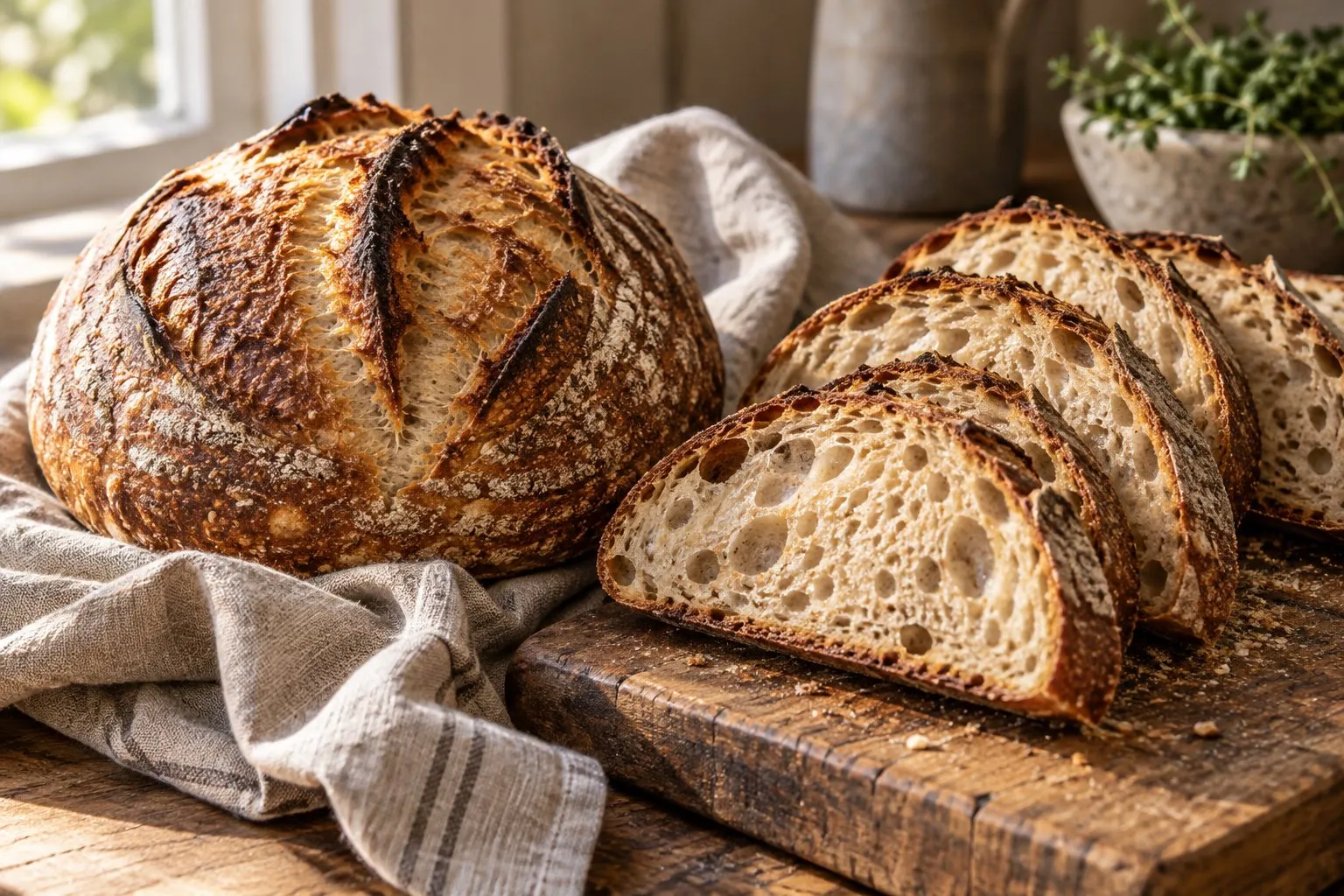
Sourdough is the loaf that most often sends people looking for a slicer. A thick, blistered crust over a soft, open crumb is hard to cut evenly with a knife: the blade skids on the crust, then tears the crumb. A slicer solves the even-thickness part. Which kind fits depends on the shape of your loaf – a wide round boule or a long batard – more than on the brand.
Our pick for sourdough: Zassenhaus Classic
Zassenhaus Classic
The classic rotary bread slicer: serrated Solingen blade, crank, beechwood base – no motor, no cord.
Why here: Serrated Solingen blade, stepless 1–18 mm and no frame around the loaf – the documented choice for crusty boules.
Best for: Households that mostly slice bread and want a brand crank slicer with documented specs and a compact footprint.
Strengths
- Stepless 1–18 mm (about 1/25–0.7 in) – from thin sandwich slices to thick toast
- Die-cast and stainless steel body on a beechwood base, four suction feet
- Smallest footprint of the brand hand-crank slicers in our comparison
Weaknesses
- No carriage and no end-piece holder listed – the last piece of the loaf needs care
- Premium price class, several times the unbranded crank slicers
- Only the blade is documented as made in Solingen; retailers list the Czech Republic as country of origin
- Type
- Hand-crank slicer for bread
- Blade
- Round serrated stainless blade, made in Solingen (diameter not stated)
- Slice thickness
- 1–18 mm stepless (about 1/25–0.7 in)
- Size
- 11.8 × 10 × 7.5 in (30 × 25.5 × 19 cm)
- Weight
- 5.3 lb (2.4 kg)
- Carriage & holder
- Beechwood base, no carriage or end-piece holder listed
Price class: Premium
View on Amazon(paid link to Amazon, opens in a new tab)Ad · paid link · check price & delivery on AmazonLearn more AdThe Zassenhaus Classic is a hand-crank slicer: one hand turns a round stainless blade with a special wave edge, the other pushes the loaf against a fence that sets the slice thickness steplessly from 1 to 18 mm (about 1/25 to 0.7 in). There are no walls around the loaf, so a wide boule does not have to fit into a slot. According to Culinaris, the body is die-cast metal and stainless steel on a beechwood base with four suction feet; it measures about 11.8 × 10 × 7.5 inches and weighs 5.3 lb.
What the spec sheet does not tell you: the blade diameter, and with it the tallest loaf that the blade cuts in one pass, is not stated. No carriage and no end-piece holder are listed, so the last piece of a crusty loaf needs care. And it sits in the premium price class. Details are on the Zassenhaus Classic page.
Which sourdough slicer fits you?
Which slicer fits you?
If you bake round, crusty boules and want a documented brand slicer → Zassenhaus Classic
View(paid link to Amazon, opens in a new tab)Ad · paid link · check price & delivery on AmazonIf you also slice cheese or salami and want a carriage with thumb guard → Graef H9
View(paid link to Amazon, opens in a new tab)Ad · paid link · check price & delivery on AmazonIf you bake batards or pan loaves and own a sharp bread knife → Akebono PS-955 guide
View(paid link to Amazon, opens in a new tab)Ad · paid link · check price & delivery on AmazonIf you want a crank slicer in the budget price class
If you are still deciding between a guide and a crank
Hand-crank slicer or guide for sourdough?
| Loaf shape | Crank slicer | Slicing guide |
|---|---|---|
| Round boule, crusty | No side walls; maximum height not stated | Too wide for a 5.5-in guide; long "sourdough round" guides exist |
| Batard (oval) | No side walls; maximum height not stated | Fits if the loaf is narrower than the guide |
| Sourdough in a loaf pan | No side walls; maximum height not stated | Fits if width and domed top stay within the guide's limits |
| Very large boule | Halve it, slice each half cut side down | Halve it first |
For the general pros and cons of both designs, see slicing guide or hand-crank slicer.
The options compared
| Comparison | Our pick: hand-crank slicerZassenhaus Classic | Our pick: bread, cheese & cured meatGraef H9 | Seller data onlyCAWIU crank slicer with cover | Seller data onlySOWKIPE hand-crank slicer | Seller data onlyBrvclon hand-crank slicer |
|---|---|---|---|---|---|
| Type | Hand-crank slicer for bread | Hand-crank food slicer with carriage | Hand-crank slicer for bread | Hand-crank slicer for bread | Hand-crank slicer for bread |
| Blade | Round serrated stainless blade, made in Solingen (diameter not stated) | 7.5 in (190 mm) serrated stainless steel | 6.6 in stainless steel, removable (listing) | – | – |
| Slice thickness | 1–18 mm stepless (about 1/25–0.7 in) | 0–15 mm stepless (up to 0.6 in) | 0–0.9 in, rotary knob with scale (listing) | adjustable (range not stated) | adjustable with scale line (listing) |
| Loaf size | – | – | – | – | – |
| Size | 11.8 × 10 × 7.5 in (30 × 25.5 × 19 cm) | 14.8 × 14.4 × 9.6 in (375 × 365 × 245 mm) | 11.8 × 7.9 × 7.3 in (listing) | – | – |
| Weight | 5.3 lb (2.4 kg) | 6.2 lb (2.8 kg) | 4.5 lb (listing) | – | – |
| Carriage & holder | Beechwood base, no carriage or end-piece holder listed | Stainless carriage with thumb guard, end-piece holder included | Metal guide, removable protective cover (listing) | – | Metal guide, suction cups, wood base (listing) |
| Best for | Households that mostly slice bread and want a brand crank slicer with documented specs and a compact footprint. | Kitchens that slice bread and also firm cheese or cured sausage without electricity. | Sourdough bakers who want a cover on the counter and accept listing data only. | Buyers who want a named brand among the budget crank slicers. | Buyers who want the hand-crank principle in the budget to mid-range price class and can live with listing data only. |
| Price class | Premium | Premium | Budget to mid-range | Mid-range | Budget to mid-range |
| On Amazon(paid link to Amazon, opens in a new tab)Ad · paid link · check price & delivery on Amazon | On Amazon(paid link to Amazon, opens in a new tab)Ad · paid link · check price & delivery on Amazon | On Amazon(paid link to Amazon, opens in a new tab)Ad · paid link · check price & delivery on Amazon | On Amazon(paid link to Amazon, opens in a new tab)Ad · paid link · check price & delivery on Amazon | On Amazon(paid link to Amazon, opens in a new tab)Ad · paid link · check price & delivery on Amazon |
Graef H9: for sourdough plus cheese and cured meat
The Graef H9 is a hand-crank food slicer with a 7.5-inch (190 mm) serrated stainless blade that Graef describes as suited to large loaves. It slices steplessly from 0 to 15 mm and comes with a removable stainless carriage with thumb guard and an end-piece holder – useful with a crusty heel that is hard to hold. The limit for sourdough lovers who like thick slices: 15 mm (0.6 in) is the maximum. It needs about 14.8 × 14.4 inches of counter space and sits in the premium price class. You can find it as Graef H9 on Amazon*.
CAWIU crank slicer with cover
The CAWIU is marketed for round sourdough loaves and comes with a removable protective cover for storage, according to the listing, which also names a 6.6-inch stainless blade and 0 to 0.9 inch. It sits in the budget to mid-range price class. The listing does not state a maximum loaf width or height, and there is no spec sheet we could read, so whether your largest boule fits is unknown.
SOWKIPE and Brvclon
Both are budget to mid-range hand-crank slicers marketed for sourdough, with adjustable thickness. The Brvclon listing adds a thickness scale, a metal guide, suction cups and a wood base. Neither states a slice range, blade size or loaf capacity. They are options for buyers who put the price class first, not picks. More budget models are in our comparison of manual bread slicers.
Slicing guides for sourdough rounds
Unbranded
13-inch guide for rounds
A long slicing guide marketed for round sourdough loaves, adjustable in width and thickness (per listing).
Seller data only
Best for: Sourdough bakers whose boules are too wide for a standard guide.
Bambüsi
Bambüsi bamboo guide with knife
A foldable Moso bamboo slicing guide with a stainless bread knife and a crumb tray in the box (manufacturer).
Best for: Anyone who has no good bread knife yet and wants guide and knife in one box.
If you prefer a guide, look for one built for rounds. The 13-inch guide for sourdough rounds is longer than standard guides and adjusts in width and thickness, per the listing; its maximum loaf height is not given. The Bambüsi bamboo guide comes with a bread knife and a crumb tray, per the maker, which helps if you do not own a good one yet; its slot widths and loaf limit come from the listing only. Both are budget class. If your crust still fights the knife, see why sourdough is hard to cut. With any guide, the cut is only as good as your bread knife and a steady sawing motion.
What to check before you buy
- Measure your loaf. Height at the tallest point, width at the widest. Compare with the spec sheet; no stated limit means the fit is unknown.
- Thickest slice you want. Zassenhaus Classic 18 mm (0.7 in), Graef H9 15 mm (0.6 in), Akebono guide up to 30 mm (1.2 in).
- Serrated blade. Standard on crank slicers; with a guide it is your knife.
- The heel. A carriage with end-piece holder (Graef H9) keeps fingers away from the blade at the end of a crusty loaf.
- Cleaning. The blade stays exposed on a crank slicer; check the manual for how to clean around it. The Akebono guide, for example, is hand-wash only.
Common mistakes with sourdough slicers
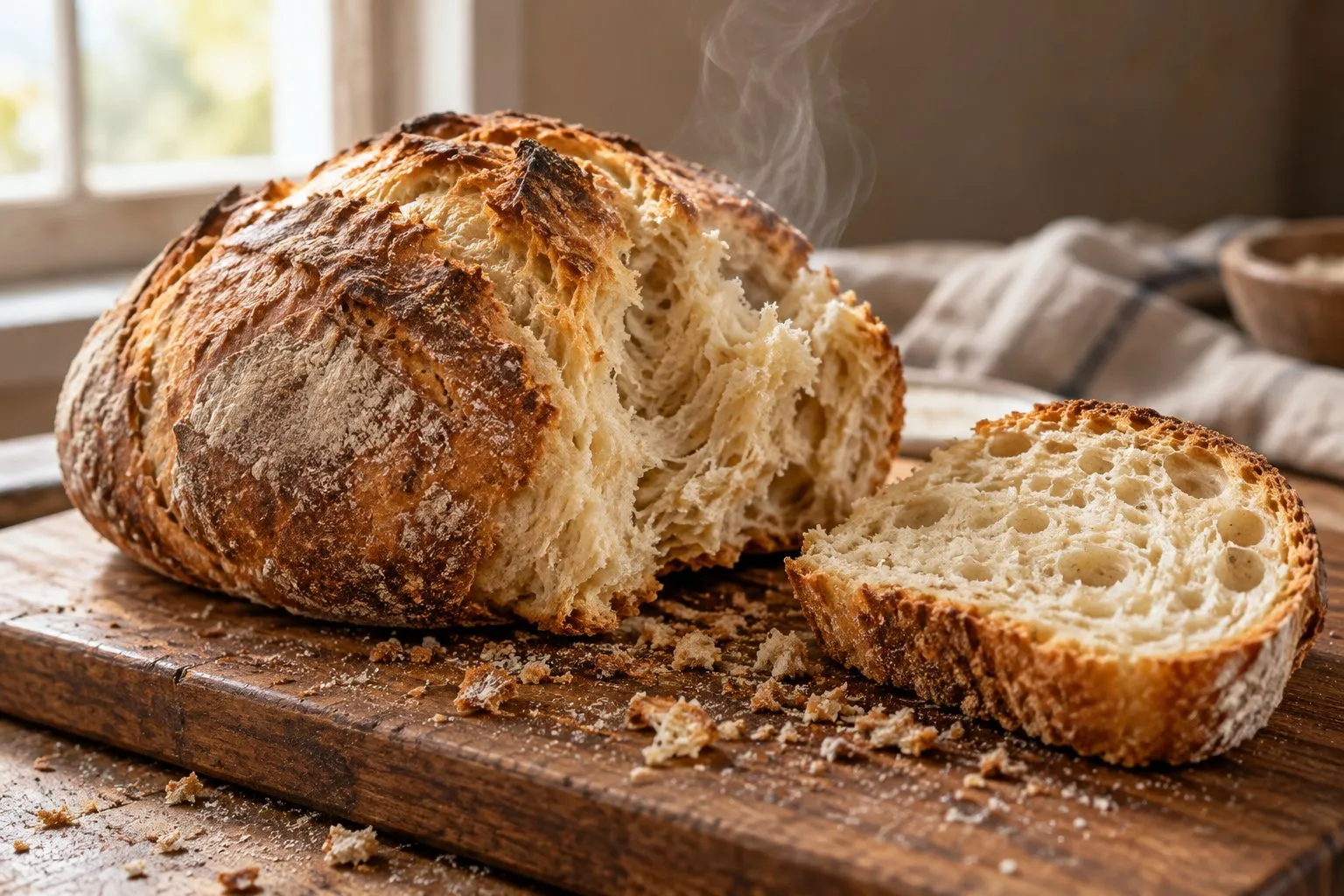
- Choosing a standard guide for a wide boule. If the loaf does not fit between the walls, it has to be trimmed or halved first.
- Expecting electric-appliance rules. A hand-crank slicer has no motor and no cord. Its risks are a base that slides, the last piece of the loaf and cleaning the exposed blade – the mechanics are explained on the hand-crank bread slicer page.
If you bake other loaves too, the page about a bread slicer for homemade bread covers sandwich and pan loaves.
Verdict
For round, crusty sourdough, buy a hand-crank slicer. The Zassenhaus Classic is our pick because its blade, slice range and size are documented and it needs no frame around the loaf. If cheese and salami matter too and you can live with 15 mm as the thickest slice, take the Graef H9. Guides make sense for batards and pan loaves – and as a budget test of whether even slices matter enough to you.
Zassenhaus Classic
The classic rotary bread slicer: serrated Solingen blade, crank, beechwood base – no motor, no cord.
Why here: Our pick for round, crusty sourdough loaves.
Best for: Households that mostly slice bread and want a brand crank slicer with documented specs and a compact footprint.
Strengths
- Stepless 1–18 mm (about 1/25–0.7 in) – from thin sandwich slices to thick toast
- Die-cast and stainless steel body on a beechwood base, four suction feet
- Smallest footprint of the brand hand-crank slicers in our comparison
Weaknesses
- No carriage and no end-piece holder listed – the last piece of the loaf needs care
- Premium price class, several times the unbranded crank slicers
- Only the blade is documented as made in Solingen; retailers list the Czech Republic as country of origin
- Type
- Hand-crank slicer for bread
- Blade
- Round serrated stainless blade, made in Solingen (diameter not stated)
- Slice thickness
- 1–18 mm stepless (about 1/25–0.7 in)
- Size
- 11.8 × 10 × 7.5 in (30 × 25.5 × 19 cm)
- Weight
- 5.3 lb (2.4 kg)
- Carriage & holder
- Beechwood base, no carriage or end-piece holder listed
Price class: Premium
View on Amazon(paid link to Amazon, opens in a new tab)Ad · paid link · check price & delivery on AmazonLearn more AdQuestions readers ask
What is the best bread slicer for sourdough?
For round, crusty sourdough loaves our pick is the Zassenhaus Classic: a hand-crank slicer with a serrated round blade made in Solingen and a stepless range of 1 to 18 mm. A crank slicer does not need a frame around the loaf, so a wide boule is less of a problem than with most slicing guides. Its maximum loaf size is not stated, though.
Can a hand-crank slicer handle a round sourdough boule?
Usually the shape is not the issue – the size is. None of the crank slicers in our comparison states a maximum loaf height or width, so the fit of a large boule is unknown before you try. If a boule turns out too tall, halving it and slicing each half cut side down is one way around it.
Is a slicing guide good for sourdough?
For batards and pan-shaped sourdough, yes, if your bread knife is sharp. For round boules, most guides are too narrow: the Akebono PS-955, the one guide with documented limits, takes loaves up to about 5.5 inches wide and 7.9 inches tall. Long guides marketed for sourdough rounds exist but do not state a maximum height.
Do I need a special blade for sourdough?
A serrated edge is the norm for crusty bread, and every crank slicer here uses one. The Zassenhaus Classic has a round stainless blade with a special wave edge, the Graef H9 a 7.5-inch serrated blade. With a slicing guide, the blade is your own bread knife, so the result depends on it.
Sources we read
Keep reading
- ComparisonBest manual bread slicersThe best manual bread slicers compared by spec sheet: Zassenhaus Classic, Graef H9, ritter manus 3 and seven budget crank slicers – slice range, size, price class.
- ComparisonGuide vs. hand crankBread slicing guide or hand-crank slicer? How loaf width, height, how often you slice, storage and price class decide – compared by spec sheet, not by opinion.
- Buying guideHand-crank slicersHow a hand-crank bread slicer works, what the spec sheets say about thickness, blade and carriage, and which rotary slicer fits your loaf – no motor, no cord.
- Buying guideHomemade breadWhich bread slicer fits homemade bread? Crank slicer or slicing guide, matched to your loaf size, slice thickness and baking rhythm – compared by spec sheet.
- Model profileZassenhaus ClassicZassenhaus Classic manual bread slicer: 1–18 mm stepless, Solingen blade, 5.3 lb, suction feet – the documented specs, what is missing and who it suits.
Who compares here
manualbreadslicer.com Editorial Team
Bread slicer comparisons & explainers
We are the editorial team at manualbreadslicer.com. We compare hand-crank bread slicers, slicing guides and their electric alternatives using manufacturer spec sheets, manuals, retailer data and primary sources such as Lemelson-MIT – with sources on every page. We do not run lab tests, and we say so openly.
- Spec sheets & manuals compared
- Sources on every page
- No lab tests – stated openly
- Publisher details in the imprint