Explainer
Types of Bread Slicers: Rotary Crank, Slicing Guide, Bow Knife, Guillotine and Electric
There are two kinds of manual bread slicer – the rotary hand-crank slicer with its own serrated round blade, and the slicing guide that steers your bread knife – plus four related tools that share the name: bow knives, guillotines, electric food slicers and electric knives. What separates them is who does the cutting and what sets the slice thickness.
Disclosure: This page contains affiliate links (marked with *). If you buy through them, we earn a small commission at no extra cost to you. As an Amazon Associate I earn from qualifying purchases. Learn more
The short version
The main types of bread slicers are the hand-crank (rotary) slicer, where a crank turns a serrated round blade and a fence sets the thickness; the slicing guide, a plastic, bamboo or steel frame for your own bread knife; the bow knife; guillotine slicers for bagels; and electric options – home food slicers, electric knives and commercial bakery machines with one fixed slice.
What's on this page
- Two families, one name
- All types at a glance
- Hand-crank slicers: the rotary type
- Slicing guides: the frame type
- Handheld slicers: knives, bow knives and clip-on guides
- Guillotine and lever slicers
- French bread and baguette slicers
- Wire bread slicers
- Electric types
- Not a slicer at all: lames and dough cutters
- Which type fits which kitchen?
- Where to go next
Two families, one name
A manual bread slicer is a kitchen device without a motor that cuts a loaf into even slices, either with a round serrated blade turned by a hand crank while the loaf is pushed on a carriage against an adjustable fence, or with a frame that guides a bread knife at a fixed thickness. Wikidata files the “bread slicer” (Q21043216) as a subclass of machine, which fits the crank slicer but not the guide. Amazon lists both families in the same searches, and a handful of other tools borrow the word “slicer” on top.
The useful question for every type is the same: what does the cutting, and what sets the thickness?
All types at a glance
| Type | What cuts | What sets the thickness | Typical example | Price class |
|---|---|---|---|---|
| Hand-crank (rotary) slicer | Round serrated blade, turned by a crank | Fence, usually stepless | Zassenhaus Classic, 1–18 mm | Budget to premium |
| Crank food slicer with carriage | Round serrated blade, crank | Fence plus sliding carriage | Graef H9, 0–15 mm | Premium |
| Slicing guide | Your own bread knife | Slots or rails in the frame | Akebono PS-955, 10–30 mm | Budget |
| Knife with clip-on guide | The knife itself | Guide attached to the blade | Listings with 1/2 and 1 inch guides | Budget |
| Bow knife | Serrated blade held in a bow | Your hand | Bow-design knives | Budget |
| Guillotine | A blade that comes down from above | Usually one cut, no setting | Bagel guillotines | Budget |
| Electric food slicer | Motor-driven round blade | Dial, up to about 1/2 inch at home | Cuisinart Kitchen Pro FS-75 | Mid-range |
| Electric knife | Two reciprocating serrated blades | Your hand | Electric carving knives | Budget |
| Commercial bread slicer | Many blades at once | Fixed by the machine | VEVOR 370 W, 12 mm | Commercial |
Hand-crank slicers: the rotary type
This is the device most people mean by a manual bread slicer, and the one behind searches for a “bread slicer wheel”. One hand turns the crank, which spins a round serrated blade. The other hand pushes the loaf against the fence. According to the retailer Culinaris, the Zassenhaus Classic sets its fence steplessly from 1 to 18 mm (about 1/25 to 0.7 inch), has a die-cast and stainless body on a beechwood base and stands on four suction feet.
A variant adds a carriage, a sliding tray that carries the loaf past the blade. Graef lists a removable stainless carriage with a built-in thumb guard and an end-piece holder for its H9, which sets 0 to 15 mm with a 190 mm (7.5 in) wave-edge blade. These all-metal crank slicers are what searches for a “metal” or “stainless steel bread slicer” usually turn up. They cut cheese and cured sausage too, but stop at a thinner maximum than the Zassenhaus.
Zassenhaus Classic
The classic rotary bread slicer: serrated Solingen blade, crank, beechwood base – no motor, no cord.
Why here: The reference rotary slicer for bread: serrated Solingen blade, crank, stepless fence from 1 to 18 mm, no motor and no cord.
Best for: Households that mostly slice bread and want a brand crank slicer with documented specs and a compact footprint.
Strengths
- Stepless 1–18 mm (about 1/25–0.7 in) – from thin sandwich slices to thick toast
- Die-cast and stainless steel body on a beechwood base, four suction feet
- Smallest footprint of the brand hand-crank slicers in our comparison
Weaknesses
- No carriage and no end-piece holder listed – the last piece of the loaf needs care
- Premium price class, several times the unbranded crank slicers
- Only the blade is documented as made in Solingen; retailers list the Czech Republic as country of origin
- Type
- Hand-crank slicer for bread
- Blade
- Round serrated stainless blade, made in Solingen (diameter not stated)
- Slice thickness
- 1–18 mm stepless (about 1/25–0.7 in)
- Size
- 11.8 × 10 × 7.5 in (30 × 25.5 × 19 cm)
- Weight
- 5.3 lb (2.4 kg)
- Carriage & holder
- Beechwood base, no carriage or end-piece holder listed
Price class: Premium
View on Amazon(paid link to Amazon, opens in a new tab)Ad · paid link · check price & delivery on AmazonLearn more AdHow the mechanism works in detail, and which models publish their data, is on the page about the hand-crank bread slicer.
Slicing guides: the frame type
A slicing guide has no blade. The loaf lies in a frame, and slots or rails keep your bread knife vertical at a fixed distance. You saw, move the loaf one step and repeat. Guides come in three materials:
- Plastic. The Akebono PS-955 is the best-documented example: five steps of 10, 15, 20, 25 and 30 mm, loaves up to 200 mm high and 140 mm wide (about 7.9 × 5.5 in), made in Tsubame, Japan, according to Globalkitchen Japan. It is the answer to most searches for a “Japanese bread slicer”.
- Bamboo or wood. Bamboo guides often add a knife and a crumb tray. They are compared on the page about the bamboo bread slicer.
- Stainless steel rails. Some foldable guides use steel guide rails on a wooden frame; see foldable bread slicers.
The limit of every guide is the frame: a loaf that is wider or taller than the walls does not go in. The full comparison is on the bread slicing guide page, and the choice between the two families on guide or hand-crank slicer.
Handheld slicers: knives, bow knives and clip-on guides
Searches for a “handheld bread slicer” mean a knife of some kind. A long serrated bread knife is the basic tool and the one a guide needs. A bow knife holds a serrated blade under tension in a wooden bow. A knife with clip-on guides attaches a thickness stop to the blade, sold for example with 1/2 and 1 inch guides. None of them has a fence on a base, so the evenness still depends on your hand, unless you add a frame.
Guillotine and lever slicers
A guillotine brings a blade down from above instead of sawing. The common household version is the bagel guillotine: the bagel sits in a cradle, the blade comes down behind a shield and splits it once. Guillotine-style slicers for whole loaves, such as the Danish Raadvad, are a separate design from the rotary crank slicer. We did not find a current manufacturer spec sheet for a lever bread slicer, so we do not compare one here. The bagel tools are covered on bagel slicers.
French bread and baguette slicers
A baguette is long and narrow, so width is rarely the problem; length and a hard crust are. We found no dedicated baguette slicer with a spec sheet in our data. In practice, a long serrated knife does the job, and some guide listings name baguettes among the loaves they take. For a crank slicer, check how much of the length the fence and base can support.
Wire bread slicers
Searches for a “wire bread slicer” exist, but we found no wire-type bread slicer with a manufacturer spec sheet. Every documented slicer in our comparison cuts bread with a serrated edge, whether round blade or knife. Until a maker publishes data for a wire design, we cannot say how it handles a crust.
Electric types
Three very different machines are sold as electric bread slicers:
- Home food slicers. A motor turns a round blade, a dial sets the thickness. The Cuisinart Kitchen Pro FS-75 is listed by the retailer Abt for bread, roasts and firm cheese, with a 7.5-inch undulated blade and a range of 1/32 to 1/2 inch, for residential use.
- Electric knives. Two serrated blades move back and forth; thickness is up to your hand.
- Commercial bread slicers. Counter machines cut a whole loaf in one pass at one fixed thickness, for example 12 mm on the VEVOR 370 W model, in a commercial price class. OSHA's fact sheet on food slicers addresses employers in grocery stores, restaurants and delis, which shows where these machines belong.
The page about the electric bread slicer explains what a home kitchen can realistically use, and the electric knife for bread covers the handheld option.
Not a slicer at all: lames and dough cutters
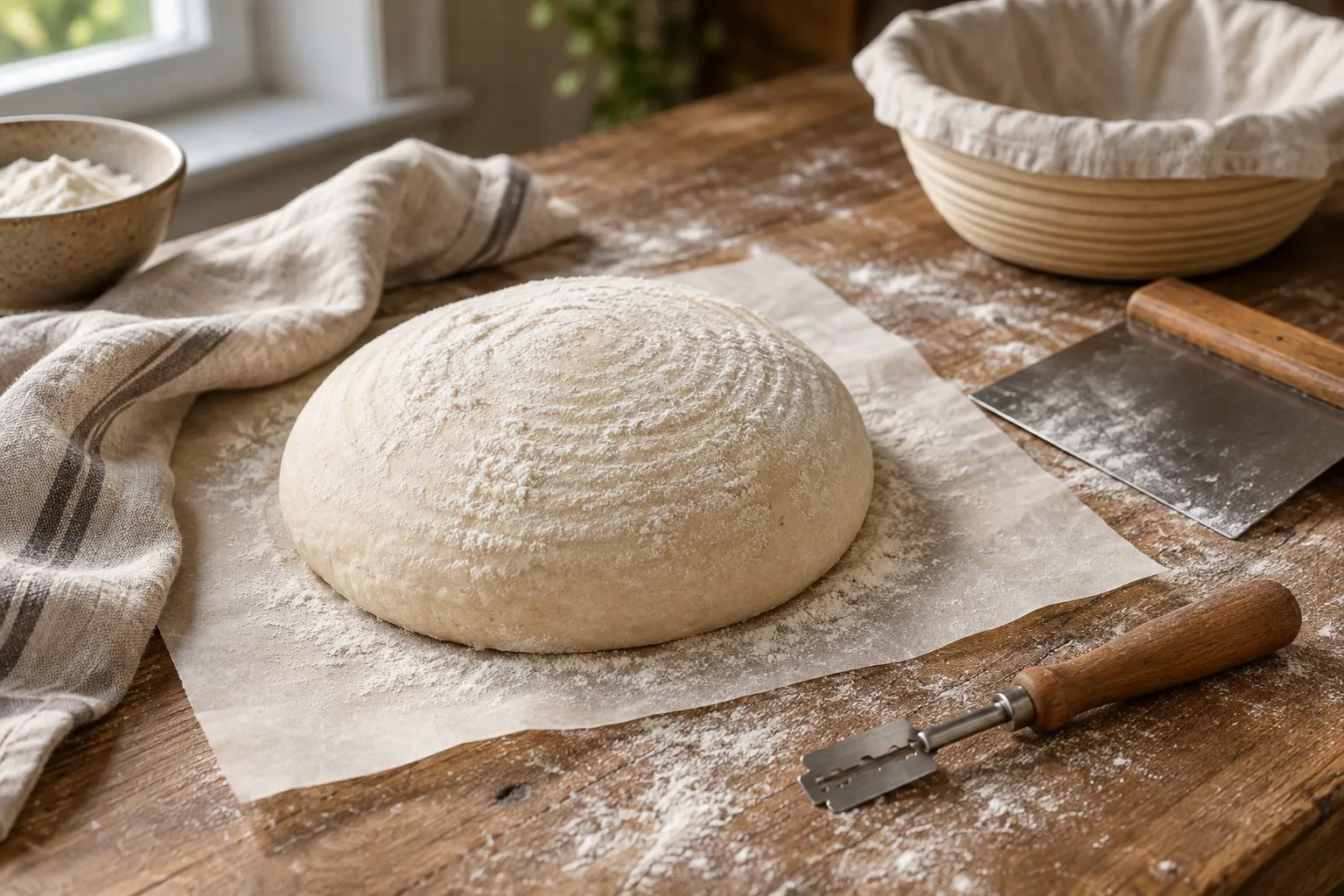
The picture at the top shows tools that turn up in “bread cutter” searches but never touch a baked loaf. A lame is a razor holder for scoring raw dough before it goes in the oven. A bench scraper or dough cutter divides dough. Neither replaces a slicer or a bread knife.
Which type fits which kitchen?
| You mostly … | Type that fits | Why |
|---|---|---|
| bake pan loaves about once a week | Slicing guide | Budget price class, fits a drawer, uses your knife |
| bake crusty or round loaves several times a week | Hand-crank slicer | No frame walls, stepless fence |
| slice bread and cold cuts | Crank food slicer with carriage | Carriage and thumb guard |
| want a motor and slices no thicker than 1/2 inch | Electric food slicer | Dial from 1/32 inch |
| split bagels and rolls | Bagel guillotine | One cut, hand out of the blade path |
Where to go next
If you already know you want a manual slicer, start with our comparison of manual bread slicers, which ranks crank slicers and guides by spec sheet. If the electric options still tempt you, bread slicing tools compared puts knives, guides and machines side by side. The terms used on this page – fence, carriage, suction feet, end-piece holder – are explained in the bread slicer glossary.
Questions readers ask
What is the difference between a bread slicing guide and a bread slicer?
A slicing guide is a frame that keeps your own bread knife straight at a fixed distance; you still saw through the loaf yourself. A hand-crank bread slicer has its own serrated round blade turned by a crank, and a fence sets the thickness, on the Zassenhaus Classic steplessly from 1 to 18 mm. Guides are lighter and sit in the budget price class; brand crank slicers are premium.
What is a rotary bread slicer?
Rotary bread slicer is another name for the hand-crank bread slicer. A round serrated blade spins when you turn the crank, and you push the loaf against a fence that sets the slice thickness. It has no motor and no cord. Some models, such as the Graef H9, add a sliding carriage with a thumb guard.
Is a bread lame a bread slicer?
No. A lame is a razor tool for scoring raw dough before baking, and a bench scraper or dough cutter divides dough. Both are sometimes sold under bread cutter search terms, but neither slices a baked loaf.
Is there a Japanese bread slicer?
The best-documented one in our comparison is the Akebono PS-955, a slicing guide made in Tsubame, Japan, with five fixed steps from 10 to 30 mm and a loaf limit of about 7.9 inches high and 5.5 inches wide. The [Tojiro bread slicer](/tojiro-bread-slicer/), by contrast, is a long bread knife, not a machine.
Sources we read
- Wikidata: Q21043216 bread slicer
- Culinaris: Zassenhaus Bread slicing machine Classic (technical data)
- GRAEF: Allesschneider Manuale H9 silber (product page, German)
- Globalkitchen Japan: Akebono bread slicer PS-955 (technical data)
- Abt: Cuisinart Kitchen Pro FS75 food slicer (specifications)
- OSHA Fact Sheet: Preventing Cuts and Amputations from Food Slicers and Meat Grinders (PDF)
Keep reading
- Buying guideHand-crank slicersHow a hand-crank bread slicer works, what the spec sheets say about thickness, blade and carriage, and which rotary slicer fits your loaf – no motor, no cord.
- Buying guideBread slicing guidesBread slicing guides compared by spec sheet: thickness steps, loaf size, knife or no knife, plastic or bamboo – and when a guide is the wrong tool for your loaf.
- Buying guideElectric bread slicersElectric bread slicer for home? Bakery machines are commercial counter units with one fixed slice; at home it means a food slicer. Specs, limits and our pick.
- ComparisonGuide vs. hand crankBread slicing guide or hand-crank slicer? How loaf width, height, how often you slice, storage and price class decide – compared by spec sheet, not by opinion.
- GlossaryGlossaryBread slicer terms explained in plain English: carriage, fence, end-piece holder, serrated blade, suction feet, slicing guide, food slicer and more – A to Z.
Who compares here
manualbreadslicer.com Editorial Team
Bread slicer comparisons & explainers
We are the editorial team at manualbreadslicer.com. We compare hand-crank bread slicers, slicing guides and their electric alternatives using manufacturer spec sheets, manuals, retailer data and primary sources such as Lemelson-MIT – with sources on every page. We do not run lab tests, and we say so openly.
- Spec sheets & manuals compared
- Sources on every page
- No lab tests – stated openly
- Publisher details in the imprint