Troubleshooting
Why Is My Sourdough So Hard to Cut? Crust, Bottom and Blade Fixes
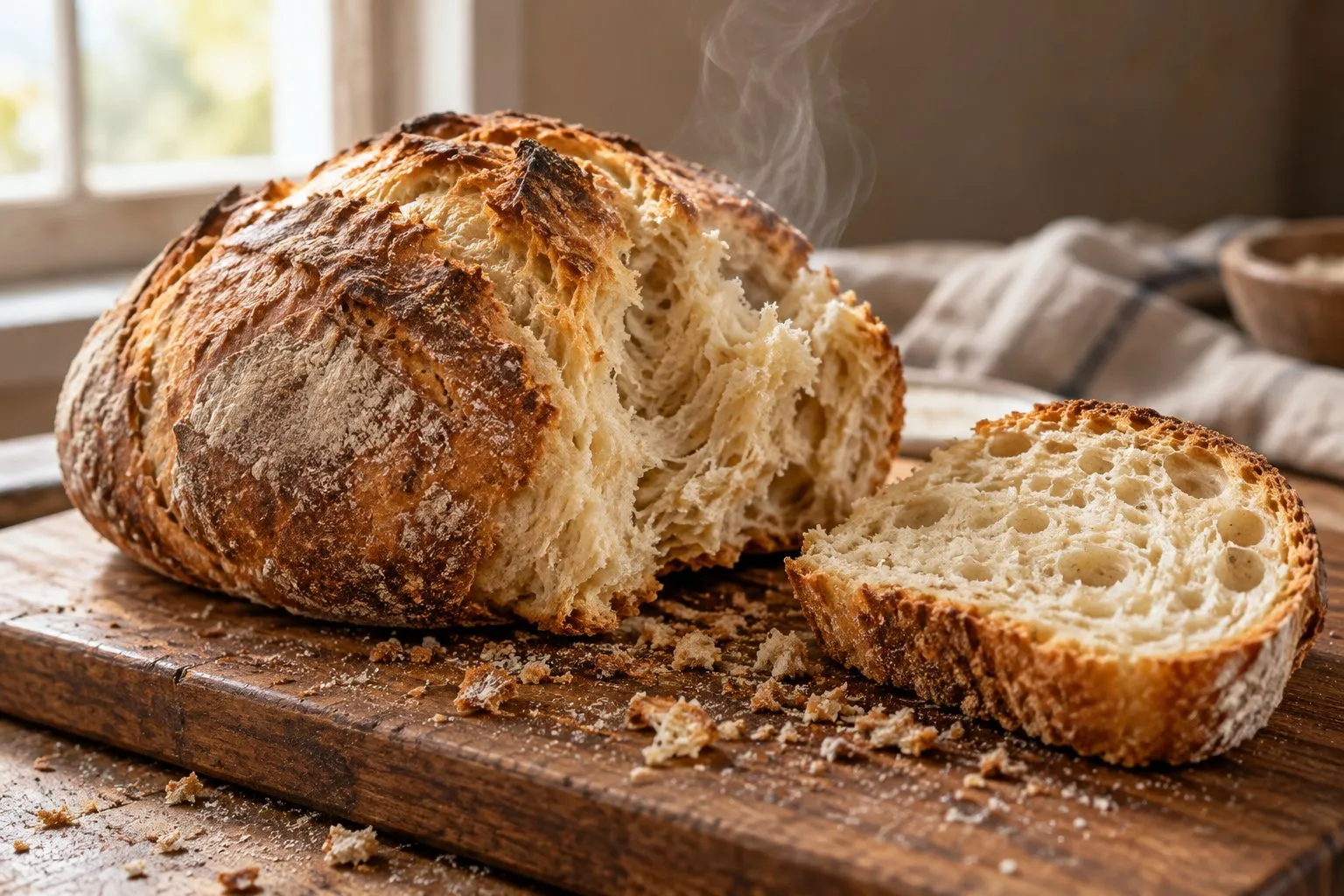
Sourdough is hard to cut mostly because its crust is meant to be: King Arthur Baking describes the crust of a crusty boule as extremely firm, yielding only when squeezed very hard. The bottom, which sits on the hot pot or stone for the whole bake, is usually the toughest part. The fixes: a long serrated knife, sawing without pressure, and cutting the loaf on its side.
Disclosure: This page contains affiliate links (marked with *). If you buy through them, we earn a small commission at no extra cost to you. As an Amazon Associate I earn from qualifying purchases. Learn more
The short version
A hard sourdough crust is normal: King Arthur Baking says crusty loaves should have extremely firm crusts. It gets harder if the loaf is overbaked, which makes bread harden and dry out. The bottom crust bakes in direct contact with a preheated pot. Fixes: let the loaf cool completely, use a serrated knife longer than the loaf, saw lightly, and turn the loaf on its side for the bottom.
Symptom: the knife will not get through
The blade skids on the top crust, stalls at the bottom, or makes it through only with force – and the soft crumb gets squashed or torn on the way. That is the most common sourdough slicing complaint. The general method for slicing a loaf is on how to slice sourdough; this page is about the loaf that fights back.
Cause 1: the crust is supposed to be firm
King Arthur Baking describes the crust of crusty artisan loaves such as boules as extremely firm, yielding only when squeezed very hard, and says sourdough can be baked darker. Baking in a covered pot adds to that: King Arthur explains that the steam trapped under the lid keeps the crust soft early on and makes it crackly-crisp once the loaf browns. A hard crust is a feature of the style, not a mistake.
Cause 2: the bottom bakes on hot iron
In King Arthur Baking's no-knead sourdough method, the dough goes into a Dutch oven preheated to 500°F, bakes covered for 45 minutes at 450°F and then 10 to 15 minutes uncovered. The bottom crust sits on the hot pot the whole time, which is why it can come out as the firmest part of the loaf. The recipe notes that you can bake the loaf on its parchment inside the pot.
Cause 3: the loaf is overbaked
King Arthur Baking warns that overbaking can cause bread to harden and dry out. If the whole crust is hard and dry rather than crisp over a moist crumb, the bake was probably too long or too hot for that loaf. Its doneness check for this recipe is a well-colored crust and an internal temperature of at least 210°F.
Cause 4: the loaf is still warm
A warm loaf does not resist with its crust but with its crumb: the inside is gummy and drags on the blade. King Arthur Baking advises letting bread cool completely before slicing; the no-knead sourdough rests at least one hour on a rack. More on timing: how long to wait before cutting sourdough.
Cause 5: the blade
A short, smooth or dull blade makes every crust feel harder. Mercer describes the wavy edge of its 10-inch Millennia bread knife as having teeth that penetrate a tough outer crust. On a hand-crank slicer, Zassenhaus notes that the circular knife may become dull after prolonged use and should then be replaced – see replacement blades.
Fix it step by step
Cool the loaf completely
Cut only when the loaf no longer feels warm at the bottom or in the center.Use a long serrated knife
The blade should be longer than the loaf is wide, so each stroke spans the crust.Saw, do not press
Long, light strokes. Pressure squashes the crumb against the hard crust.Halve a round boule first
Cut through the center, then lay each half cut side down and slice across.Turn the loaf on its side for the bottom
With the loaf on its side, the knife meets top and bottom crust at the same time instead of stalling on the base at the end of the cut.Check the next bake
If the whole crust is hard and dry, judge doneness by crust color and internal temperature, as King Arthur Baking describes, rather than by the clock alone.
When a slicer makes sense
If you bake sourdough every week and the knife work is the problem, a hand-crank slicer takes over the sawing: the Zassenhaus manual says to press the bread lightly against the slicer and turn the crank, and for soft bread to turn quickly while pushing slowly. The Zassenhaus Classic cuts steplessly from 1 to 18 mm (about 1/25 to 0.7 in) with a serrated blade made in Solingen. Which slicers suit round, crusty loaves is compared on the sourdough bread slicer page. If you stay with a knife, the options are on the best bread knife for sourdough.
Mercer Millennia 10" bread knife
A 10-inch wavy-edge bread knife from a foodservice cutlery maker – the tool every slicing guide needs.
Why here: A 10-inch wavy-edge bread knife whose teeth are made for tough crusts – the first fix for a sourdough that is hard to cut.
Best for: Anyone who slices with a guide or freehand and needs a long serrated knife for crusty loaves and bagels on a board.
Strengths
- 10 in (25.4 cm) blade of one-piece high-carbon Japanese steel, 15° edge, HRC 53–54 (manufacturer)
- Wavy edge meant to get through a tough crust without tearing the soft crumb (manufacturer)
- Santoprene handle with finger guard, NSF certified, limited lifetime warranty (manufacturer)
Weaknesses
- Hand wash only – Mercer says cutlery should never go in a dishwasher
- No fence: slice thickness depends on your hand unless you add a guide
- Type
- Serrated (wavy edge) bread knife
- Blade
- 10 in (25.4 cm), high-carbon Japanese steel, 15° edge, HRC 53–54
- Slice thickness
- freehand – set by your hand or a slicing guide
Price class: Budget
View on Amazon(paid link to Amazon, opens in a new tab)Ad · paid link · check price & delivery on AmazonAdQuestions readers ask
Why is the bottom of my sourdough so hard to cut?
The bottom crust bakes in direct contact with the pot or stone. In King Arthur Baking's no-knead sourdough method, the dough goes into a Dutch oven preheated to 500°F, bakes covered for 45 minutes at 450°F and then 10 to 15 minutes uncovered, all the time sitting on the hot pot. Turn the loaf on its side and saw through the bottom and top crust at the same time, with a long serrated knife.
Is a very hard sourdough crust a sign of a bad bake?
Not by itself. King Arthur Baking says crusty artisan loaves should have extremely firm crusts that only yield when squeezed very hard, and that sourdough can be baked darker. A crust that is hard and dry all the way through can point to overbaking, which King Arthur says makes bread harden and dry out.
Why does my sourdough crumb tear when I cut it?
Usually because the loaf is still warm. King Arthur Baking advises letting bread cool completely before slicing, or the interior turns gummy; its no-knead sourdough recipe rests at least one hour on a rack. If a fully cooled loaf still tears, the knife or the slicer blade is the next suspect.
Sources we read
- King Arthur Baking: How to tell if bread is done baking
- King Arthur Baking: How to make no-knead sourdough bread
- King Arthur Baking: 10 tips for new sourdough bakers
- Mercer Culinary: Millennia Wavy Edge Wide Bread Knife 10 in (product page)
- Zassenhaus: Bread slicer CLASSIC user's guide (PDF, Küchenprofi Group)
Keep reading
- How-toHow to slice sourdoughHow to cut sourdough bread evenly: cool the loaf, halve a round boule, saw with a long serrated knife – plus the method for guides and hand-crank slicers.
- Question & answerHow Long Should You Wait Before Cutting Sourdough – and What Happens If You Cut Too Early?How long to wait before cutting sourdough: cool it completely, at least an hour per King Arthur, longer for rye. What cutting a hot loaf does to the crumb.
- Buying guideSourdough bread knifeWhich sourdough bread knife cuts a crusty boule cleanly? Blade length, serrated edges and bow knives explained, with our pick and the alternatives compared by spec.
- Buying guideSourdough slicersWhich sourdough bread slicer handles a crusty boule? Hand-crank slicers and slicing guides for round loaves compared by spec sheet, with loaf-size limits.
- TroubleshootingReplacement bladesBread slicer blade tearing the loaf? How to tell a dull blade, why makers say replace instead of sharpen, and which spare blades Zassenhaus, ritter and Graef list.
Who compares here
manualbreadslicer.com Editorial Team
Bread slicer comparisons & explainers
We are the editorial team at manualbreadslicer.com. We compare hand-crank bread slicers, slicing guides and their electric alternatives using manufacturer spec sheets, manuals, retailer data and primary sources such as Lemelson-MIT – with sources on every page. We do not run lab tests, and we say so openly.
- Spec sheets & manuals compared
- Sources on every page
- No lab tests – stated openly
- Publisher details in the imprint