Question & answer
How Do Bakeries Slice Their Bread?
Bakeries slice bread with a dedicated bread slicing machine: the cooled loaf is pushed or pulled through a set of blades that cut every slice at once, at a thickness set by the machine. Makers such as JAC sell semi-automatic models, where staff place the loaf and pull a lever, and automatic ones, plus self-service slicers for shops.
The short answer
Bakeries use a bread slicing machine, not a knife. The loaf goes through a set of blades that cut the whole loaf in one pass, either at a fixed thickness or at a setting such as 5 to 25 mm on JAC's Varia Pro. Staff load semi-automatic models by hand; automatic ones start on their own. Loaves are cooled completely before slicing.
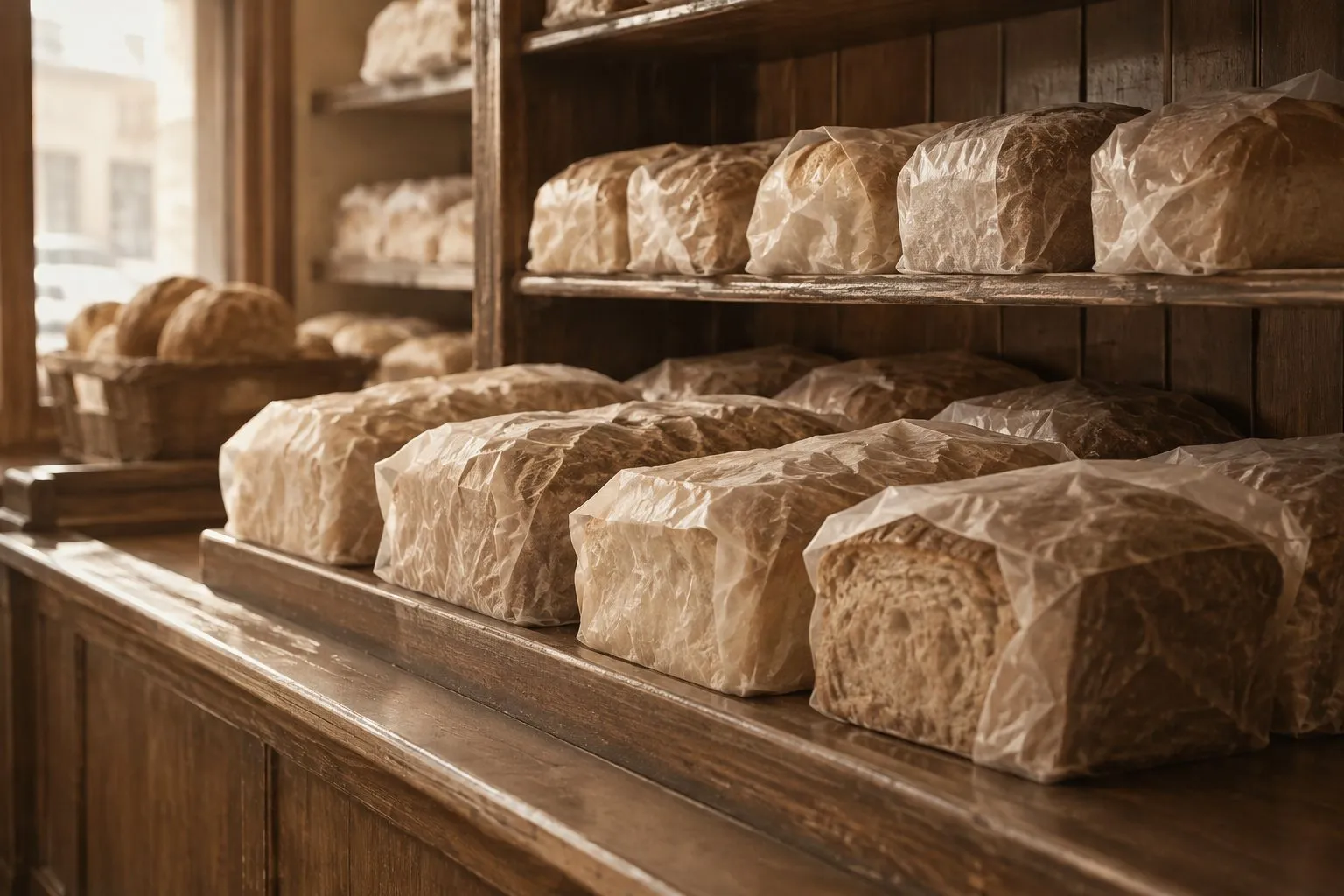
The short answer: one machine, one pass, the whole loaf
A bakery does not slice loaf by loaf with a knife. It uses a bread slicing machine that cuts all the slices of a loaf in one pass. The blades sit at a fixed spacing, and that spacing is the slice thickness – which is why bakery bread comes out so even. The machines are electric counter or floor units built for hundreds of loaves; they are covered as products on commercial bread slicers.
How the machine works
The principle goes back to the first machine that sliced bread for sale. Otto Rohwedder's patent US 1,867,377, filed on November 26, 1928, describes several endless bands of thin spring steel, each with a knife edge, running side by side. Neighboring bands run in opposite directions, which the patent says keeps the bread from being crushed or pushed out of place. Adjustable arms move the bands closer together or further apart to set the slice thickness. Fingers on a feed belt push the loaf through the bands, and a delivery belt carries the sliced loaf on to wrapping.
Today's machines are built differently in detail, but the idea is the same: the loaf passes once through a set of blades and leaves as a stack of slices. JAC, a maker of bakery slicers, uses the term “frame slicer” for this type and contrasts it with its Slim Self, a self-service model with a circular blade and a vertical cutting system that, according to JAC, takes much less space than a frame slicer.
Fixed or variable thickness
Bakery slicers come with a fixed or a variable slice thickness. JAC lists, for example:
| JAC model | Operation | Slice thickness | Output |
|---|---|---|---|
| Pico | assisted lever | fixed | not stated |
| Duro | assisted lever | not stated | not stated |
| Varia Pro (for artisan breads) | not stated | variable, 5 to 25 mm | not stated |
| Integra Pro | not stated | variable, 4 to 30 mm | not stated |
| Swift, Chute | not stated | not stated | about 300 loaves per hour |
| Full | not stated | not stated | about 500 loaves per hour |
The machines come as table models or on a trolley and with a cutting width of 45 or 60 cm, and JAC names a removable crumb tray among their features. Even JAC's lever-operated Pico, which the maker calls a manual bread slicer, is a professional machine for bakeries, not a kitchen tool.
Semi-automatic, automatic and self-service
- Semi-automatic: staff place the loaf, and the machine cuts it. On JAC's lever models, a progressive traction lever is meant to reduce the effort.
- Automatic: the machine starts on its own once loaded; JAC calls the feature Automode.
- Self-service: some shops put a slicer on the sales floor so customers can slice their bread when they buy it. JAC lists automatic loaf holding, a touch screen and a removable crumb tray for these models, and locking covers on its New Self.
Why bakeries let the bread cool first
JAC's advice to bakeries is to let loaves cool completely before slicing; slicing warm bread can cause uneven cuts. The same rule applies at home, whatever tool you use – see when to cut sourdough for the timing on crusty loaves.
How this differs from a home bread slicer
A manual bread slicer for the home works the other way round: it cuts one slice at a time. A hand-crank slicer turns a round serrated blade while you push the loaf against a fence; a slicing guide keeps your own knife straight. That is slower, but it lets you change the thickness for every slice and fits on a counter. The bakery-style electric machines sold online are commercial units – the VEVOR bread slicer in our data is listed at 370 W, 120 V and a fixed 12 mm – which is explained on electric bread slicers. All slicer designs side by side are on types of bread slicers, and the story of the first slicing machine is on bread slicer history. If you want bakery-even slices at home, start with the hand-crank bread slicer.
Questions readers ask
Why is bakery bread sliced so evenly?
Because the machine, not a hand, sets the thickness. A bakery slicer cuts the whole loaf in one pass with blades at a fixed spacing, so every slice in the loaf comes out the same. Rohwedder's 1928 patent already worked this way: parallel steel bands whose spacing set the slice thickness. A home slicer cuts one slice at a time against a fence.
Can a bakery slice a whole loaf for me?
That depends on the shop. Some stores put a self-service slicer on the sales floor: JAC sells self-service models that let customers slice their bread when they buy it, with automatic loaf holding, a touch screen and locking covers. Whether a given store slices loaves is up to the store; ask at the counter.
Can I buy a bakery bread slicer for home?
You can, but it is a commercial counter machine, not a household appliance. The VEVOR electric bread slicer in our data is listed at 370 W, 120 V and one fixed slice thickness of 12 mm, in a price class far above any home slicer. At home, a hand-crank slicer, a slicing guide or an electric knife does the job.
Sources we read
- JAC: Professional bread slicers (range overview, French)
- JAC: Bread slicers for professionals (range overview, English)
- JAC: Self-service bread slicers
- JAC: Bread slicing machine (article, North America)
- JAC: Manual bread slicer for bakeries (article, North America)
- Google Patents: US 1,867,377 – Machine for slicing an entire loaf of bread at a single operation (Rohwedder)
Keep reading
- Buying guideCommercial bread slicersCommercial bread slicers explained: how bakery machines slice a whole loaf, what JAC, Oliver, Berkel and VEVOR offer and why they do not fit a home kitchen.
- Buying guideElectric bread slicersElectric bread slicer for home? Bakery machines are commercial counter units with one fixed slice; at home it means a food slicer. Specs, limits and our pick.
- ExplainerBread slicer historyWho invented the bread slicer and when? Otto Rohwedder's whole-loaf machine, the first sliced loaf on July 7, 1928, the 1917 fire and the 1943 sales ban – sourced.
- ExplainerTypes of bread slicersThe types of bread slicers explained: rotary hand-crank, slicing guide, bow knife, guillotine, food slicer and electric knife – how each cuts and what it suits.
- Question & answerCan You Slice Bread With a Meat Slicer?Yes, a meat slicer can slice bread if its blade is serrated and the maker lists bread – up to about 1/2 inch on home models. Blade, thickness and cleaning.
Who compares here
manualbreadslicer.com Editorial Team
Bread slicer comparisons & explainers
We are the editorial team at manualbreadslicer.com. We compare hand-crank bread slicers, slicing guides and their electric alternatives using manufacturer spec sheets, manuals, retailer data and primary sources such as Lemelson-MIT – with sources on every page. We do not run lab tests, and we say so openly.
- Spec sheets & manuals compared
- Sources on every page
- No lab tests – stated openly
- Publisher details in the imprint